As the Hudson Yards project prepares to start construction on Manhattan's west side, Justin Davidson examines the plans for the borough's "largest remaining chunk of emptiness" and shares exclusive new renderings.


At 12 million square feet spread over 26 acres atop the rail yards that stretch west from Penn Station, Hudson Yards is the "country's largest and densest real-estate development." With the first, $6 billion phase of developer Related Companies' project set to begin construction in a few weeks, with an expected 2017 completion date, Davidson asks if a private developer can "manufacture a complete and authentic high-rise neighborhood in a desolate part of New York."
"New York has always grown in nibbles and crumbs, and only occasionally
in such great whale-gulps of real estate," observes Davidson. "In the richest, most layered
sections of the city, each generation's new buildings spring up among
clumps of older ones, so that freshness and tradition coexist. A project
of this magnitude, concocted around a conference table, could easily
turn out to be a catastrophe."
"The centrally planned district has its
success stories-most famously, Rockefeller Center. Coordinated frenzies
of building also produced Park Avenue, Battery Park City, and the
current incarnation of Times Square. But this enterprise is even more
ambitious than any of those, and more potentially transformative than
the ongoing saga of the World Trade Center. New York has no precedent
for such a dense and complex neighborhood, covering such a vast range of
uses, built in one go."
Read the full story: From 0 to 12 Million Square Feet

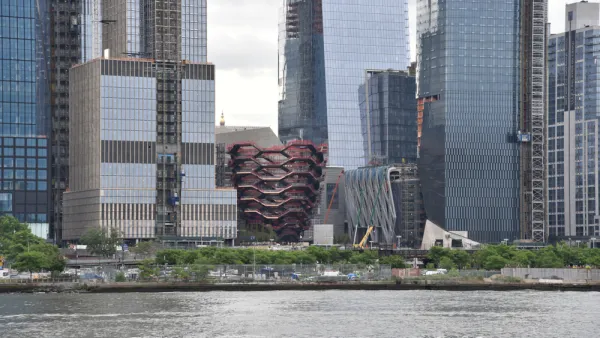
Promised Data-Driven Infrastructure On Hold at Hudson Yards
When the Manhattan megadevelopment got its start, big data was a major part of Hudson Yards' marketing pitch. Now it's "probably the last thing we'll get to."
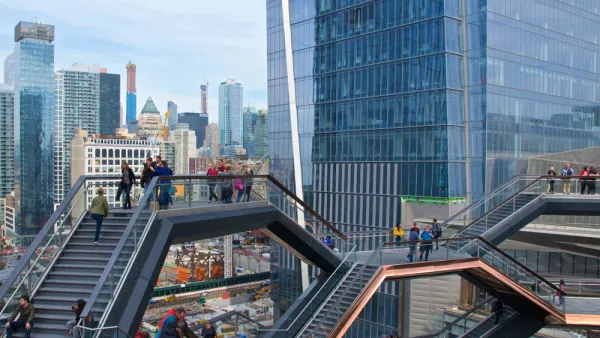
Suicides Prompt New Public Access Rules for the Vessel at Manhattan's Hudson Yards
The Vessel is reopening after closing for four months due to a rash of suicides.
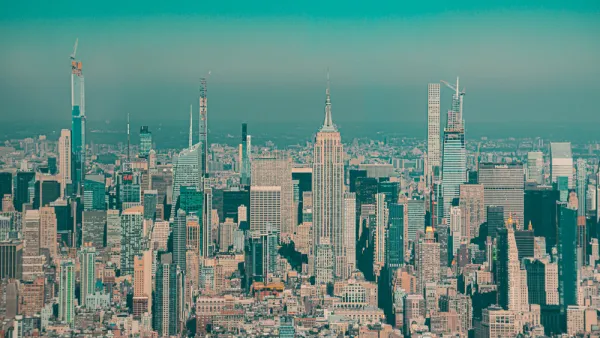
Vote for New York City's 'Building of the Year'
New York is still a place of bold architecture.

Planetizen Federal Action Tracker
A weekly monitor of how Trump’s orders and actions are impacting planners and planning in America.

Amtrak, CN end decades-long dispute with eight-year agreement
The new operating agreement establishes an updated framework for the companies to work together, including processes to resolve disputes.

Judges permit Denver to divert 77,000 acre feet from the Colorado River for reservoir expansion
Overuse and climate change have caused the Colorado River’s water levels to plummet.

NYC DOT wants faster, more permanent street upgrades
The city is examining ways to build more concrete infrastructure without getting entangled in 'decades-long' projects.

'Something we’ve never seen before:' rising utility rates could strain city finances nationwide
Data centers, climate change and other factors have caused utility rates in the United States to increase by 38% since 2020.

Trump to overrule local leaders, lease millions of acres of America’s Pacific Island territories’ seafloors to mining companies
International law says that the Indigenous people of America’s territories have a right to prior and informed consent regarding projects that impact their countries.

FREE Course: Walkable City 1: Why Walkability?
After describing his path towards focusing on walkability as the essence of good planning, Jeff Speck marches through his five principal reasons for making more walkable places.
Reinventing Malls: Planning Alchemy—Turning Gray Fields Into Gold
The course focuses on the opportunities and imperatives that shape reinvention of mall sites.

KFH Group Inc.
Greater Baltimore Committee
Eagle County Government
The Architects Foundation
University of Cincinnati Online
The Pocatello Development Authority
The Urban Renewal Agency of the City of Pocatello