Would raising the gas tax to $1 and establishing a 'gasoline price floor' provide market stability for auto dealers? Some dealers, including the nation's largest, say 'yes'. Economists agree. Politically impossible? Read on.


National Journal's energy and environment correspondent, Coral Davenport goes to "the heart of the Southern California car market" to speak with an auto dealer who supports a a more than 500-percent increase in the gas tax to $1 because it would bring "market certainty".
The fluctuating price of gasoline creates market uncertainty for dealers, meaning sales of SUVs and efficient compacts vary with the price of gas, according to the Morovia dealer.
"A growing number of car dealers advocate the same solution to the problem: raise the gasoline tax, enough to create a consistent, predictable demand for fuel-efficient cars and to force automakers to build gas-sippers that people want and can afford. One way to do this, say automakers, would be to create a new gasoline price floor -a point below which prices won't fall."
Not a new concept, Washington Post conservative columnist Charles Krauthammer wrote about it in 2004, as did University of CA energy expert Severin Borenstein (Planetizen, 2008).
Michael Jackson, chief executive officer of AutoNation, the world's biggest auto retailer, is an outspoken gas tax advocate. In April, he told CNBC: "At the end of the day, you would need a gas tax, increased over decades, to keep the consumer focused on conservation."
"Two of our biggest problems, as an economy, is our dependence on oil and our contribution to climate change. A gas tax gets at all of these neatly, elegantly, and efficiently," says James Sallee, an expert on energy and tax policy at the University of Chicago.
"We know clearly and convincingly that new-car purchases are responsive to price fluctuations. It sends a market signal, instead of having government regulations pick what we do", says Sallee.
"That idea, of course, is tantamount to jumping on a political hand grenade, which is why the politicians these economists advise haven't tried to do it.
The solution there could be a tax trade-off: raise the tax on gasoline but make an equivalent cut on payroll or income taxes."
Thanks to MTC-ABAG Library
Read the full story: $1 Gas Tax? One Auto Dealer Says, ‘Yes, Please’

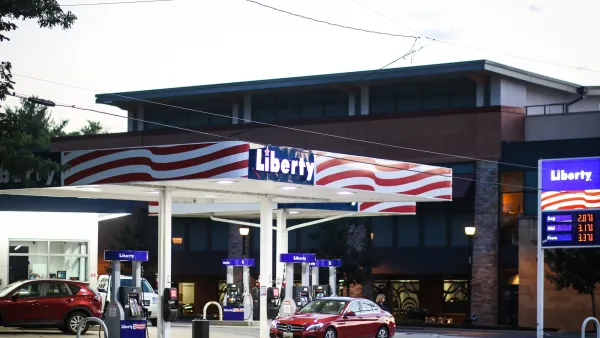
Why does Maryland's gas tax change every year?
The state's annual gas tax update may still not be enough to keep up with changes in the transportation sector and rising project costs.
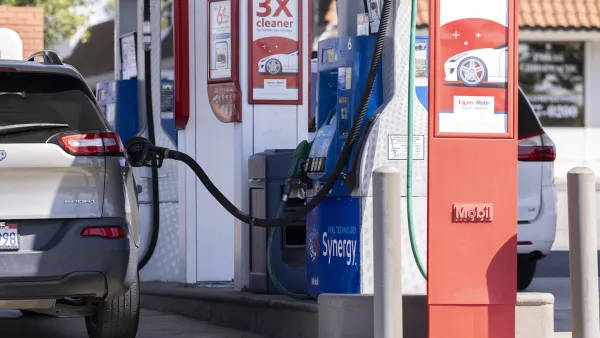
Analysis: Suspending the gas tax wouldn't save Americans much on gas this summer
Even if Congress approves a proposal to temporarily lift the federal gas tax, a variety of other factors and transportation and processing delays would mean American consumers would see little difference at the pump.
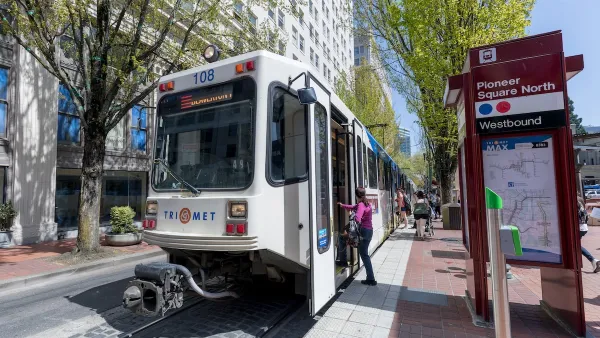
Oregon Transportation Bill Saves 500 ODOT Jobs, but Leaves Future Funding Uncertain
A bill passed in a special legislative session will raise over $4 billion for transportation and public transit in the next 10 years, but fails to establish a long-term funding solution.

Planetizen Federal Action Tracker
A weekly monitor of how Trump’s orders and actions are impacting planners and planning in America.

Amtrak, CN end decades-long dispute with eight-year agreement
The new operating agreement establishes an updated framework for the companies to work together, including processes to resolve disputes.

Northwest rail fans eager for Sept. 30 debut of Amtrak’s Airo fleet
Get ready for that new train smell and more seats. But they won’t go faster or run more frequently on the Cascades route in Washington and Oregon.

LAX SkyLink opening delayed again, contractor won’t commit to new deadline
The project was supposed to open its doors to the public in 2023.

Caltrain may slash over one-third of its stations
If Bay Area voters reject two transit tax measures, Caltrain, BART and AC Transit will see steep service cuts.

A 'dangerous' precedent: North Carolina successfully pressures communities into voting for toll roads
Two mayors resigned from the Charlotte Regional Transportation Planning Organization after it voted in favor of the toll roads.

FREE Course: Walkable City 1: Why Walkability?
After describing his path towards focusing on walkability as the essence of good planning, Jeff Speck marches through his five principal reasons for making more walkable places.
Reinventing Malls: Planning Alchemy—Turning Gray Fields Into Gold
The course focuses on the opportunities and imperatives that shape reinvention of mall sites.

City of Thousand Oaks
City of Wisconsin Rapids
Harvard University Graduate School of Design
The Architects Foundation
University of Cincinnati Online
The Pocatello Development Authority
The Urban Renewal Agency of the City of Pocatello