With construction beginning, Michael Cabanatuan reports on the unresolved problems dogging San Francisco's $1.6 billion Central Subway project.


In the works since 2000, the 1.7 mile Central Subway project will extend the T-Third Muni Metro line from downtown to Chinatown, as the first part of an effort to, "deliver reliable transit service to the underserved northeastern section
of the city, especially Chinatown, which has the city's most
transit-dependent population."
However, as construction crews build the staging area where two tunnel-boring machines will start the excavation, "the Municipal Transportation Agency
is still awaiting word on whether - and when - it will get a $942
million federal funding guarantee it's been awaiting for months," writes Cabanatuan. The project also faces opposition from residents and businesses around Union Square and North Beach, including the threat of lawsuits.
So why the rush to get started? "Kristen Holland, a transportation agency spokeswoman, said the city expects to get the federal funding guarantee in September."
Subway foes Save Muni, who want work to wait "at least until federal funding is guaranteed," see a different reason: "The MTA's motivation is for public relations: to create a sense of inevitability to get funding," said Howard Wong, a member of the group. "They're moving ahead with this to fund their staff rather than protecting taxpayers."
Read the full story: Central Subway work starts amid problems
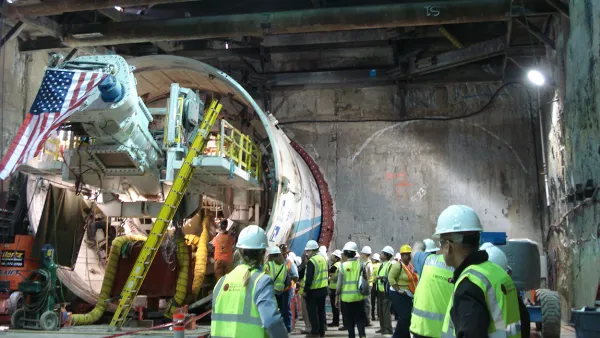
Seattle's Envy? San Francisco's Big Alma Outperforms Big Bertha
Big Alma is one of two boring machines used to tunnel under the streets of San Francisco to construct the new Central Subway to Chinatown. Big Bertha, Seattle's infamous tunnel borer, has been stalled since December. Big Alma emerged on June 11.
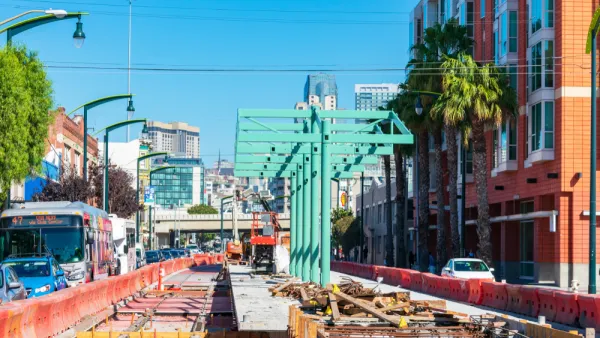
Long Delayed, $1.95 Billion Central Subway Opens in San Francisco
San Francisco’s first north-south subway opened last weekend, extending service on Muni’s T light rail line.
2021 Opening Expected for San Francisco's Central Subway
Mark your calendars (but maybe use pencil).

Planetizen Federal Action Tracker
A weekly monitor of how Trump’s orders and actions are impacting planners and planning in America.

California plans to bury El Niño’s downpour
If the state plays its cards right, it may be able to store a billion acre-feet of El Niño’s water in aquifers.

Desperate measures: Advocates weigh draining Lake Powell to fill Colorado River
Draining the reservoir could reduce evaporation losses by a couple hundred thousand acre-feet.

Los Angeles just elected an urban planner as its mayor
Transportation analysts are optimistic that Raman will be more aggressive in addressing transit issues than Bass.

Mamdani’s pied-à-terre tax survives legal challenge
A panel of judges found that the plaintiffs failed to demonstrate injury as a result of New York City's implementation of the tax.

Eastern Nebraska is running out of electricity
Data centers and electrification are straining eastern Nebraska’s grid, throttling economic development.

FREE Course: Walkable City 1: Why Walkability?
After describing his path towards focusing on walkability as the essence of good planning, Jeff Speck marches through his five principal reasons for making more walkable places.
Reinventing Malls: Planning Alchemy—Turning Gray Fields Into Gold
The course focuses on the opportunities and imperatives that shape reinvention of mall sites.

City of Rosemead
Rutgers University, Edward J. Bloustein School of Planning and Public Policy
One Hundred Miles
University of Michigan School for Environment and Sustainability (SEAS)
Hunter College, City University of New York (CUNY)
The Architects Foundation
City of Cambridge
Montrose County
The Pocatello Development Authority