Stalled for years by the recession, Sam Allen looks at the prospects for the revival of ambitious plans to remake L.A.'s Grand Avenue.


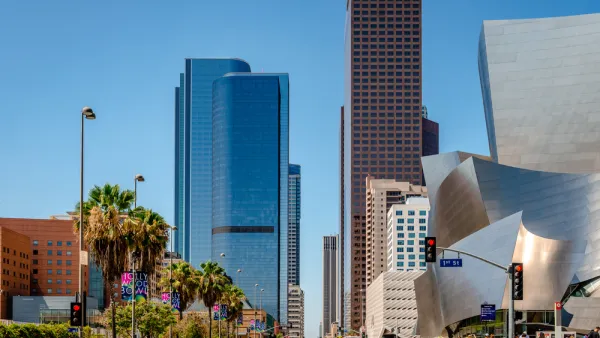
A remnant of the city's destructive and disruptive urban renewal efforts of the middle of the last century, the site of the ambitious Frank Gehry-designed Grand Avenue project is an unsightly desert of parking located smack in the middle of downtown L.A.'s most prominent cultural, business, and civic area. Born a decade ago in the high-flying days of the housing boom, and anchored by developer Related Companies, the stalled project aimed at transforming this desert into a massive $3 billion collection of high-rise towers, shops, upscale condos and a five-star hotel.
Now, according to Allen, the project may be stirring back to life, albeit in a revised form, "Bill Witte, president of Related California, said that the firm was working to adjust its plans to better reflect market conditions, and that its 'dimensions, scope and scale' could be adjusted. He did not reveal specific details but suggested the new plans would be aimed at getting the project off the ground."
"We still believe we can create some of the highest values downtown....But do I think we have to be a little bit less ambitious? Yes, I would agree with that," Witte said. "The city's and the county's expectation is that they want something with vision and that is doable. I don't think anybody is interested in pie-in-the sky talk."
"Under its amended agreement, Related must begin construction by February 2013 - or obtain yet another extension from the board of city and county officials overseeing the project. Related is expected to bring new plans to the board this year."
Read the full story: Stalled Grand Avenue development may get a second look

Gehry's Latest Downtown L.A. Project Rises While Workers Stay Home
A high-profile project in the heart of the cultural and civic center of Downtown Los Angeles is rising quickly, and practically in secret, as the area's daytime population stays home during the pandemic.
Can Frank Gehry Avoid Repeating Downtown Los Angeles’ Mistakes?
The high profile Grand Avenue project in Los Angeles’ Downtown Civic Center had been stuck in recession purgatory for years, until updated design plans by Frank Gehry were announced. Can the new development avoid the failures of Grand Avenue’s past?
Frank Gehry Rides to Grand Avenue's Rescue; Will Officials Cheer or Jeer?
Christopher Hawthorne reports that Frank Gehry is back in charge of the design for the quixotic $650-million Grand Avenue redevelopment after a disastrous redesign nearly scuttled the star-crossed project.

Planetizen Federal Action Tracker
A weekly monitor of how Trump’s orders and actions are impacting planners and planning in America.

Amtrak, CN end decades-long dispute with eight-year agreement
The new operating agreement establishes an updated framework for the companies to work together, including processes to resolve disputes.

Judges permit Denver to divert 77,000 acre feet from the Colorado River for reservoir expansion
Overuse and climate change have caused the Colorado River’s water levels to plummet.

NYC DOT wants faster, more permanent street upgrades
The city is examining ways to build more concrete infrastructure without getting entangled in 'decades-long' projects.

'Something we’ve never seen before:' rising utility rates could strain city finances nationwide
Data centers, climate change and other factors have caused utility rates in the United States to increase by 38% since 2020.

Trump to overrule local leaders, lease millions of acres of America’s Pacific Island territories’ seafloors to mining companies
International law says that the Indigenous people of America’s territories have a right to prior and informed consent regarding projects that impact their countries.

FREE Course: Walkable City 1: Why Walkability?
After describing his path towards focusing on walkability as the essence of good planning, Jeff Speck marches through his five principal reasons for making more walkable places.
Reinventing Malls: Planning Alchemy—Turning Gray Fields Into Gold
The course focuses on the opportunities and imperatives that shape reinvention of mall sites.

Harvard University Graduate School of Design
KFH Group Inc.
Greater Baltimore Committee
The Architects Foundation
University of Cincinnati Online
The Pocatello Development Authority
The Urban Renewal Agency of the City of Pocatello