According to James A. Bacon, "Smart growth is too important to leave to liberals." In a new essay, he argues that "Conservatives must articulate their own vision for creating prosperous, livable and fiscally sustainable communities."


In an essay that has been adapted from a speech delivered at the 2012 Congress for the New Urbanism, James Bacon argues:
"Many conservatives perversely defend the institutional arrangements that have created contemporary suburbia, with its scattered, low-density, disconnected and car-dependent pattern of development. But that is a disastrous mistake. Conservatives need to systematically apply their principles to transportation and land use with the goal of creating smarter, more efficient patterns of growth."
Bacon takes a crack at enumerating what some general conservative transportation and land use policies might look like:
- Roll back government regulation of the real estate marketplace.
- Restore homeowner property rights.
- Encourage innovation in real estate development.
- Deregulate mass transit.
- Make growth pay its own way.
- Adopt user pays transportation.
- Prioritize by ROI.
Thanks to Hamilton Lombard
Read the full story: Smart Growth for Conservatives
Community is Common Ground for Liberals and Conservatives
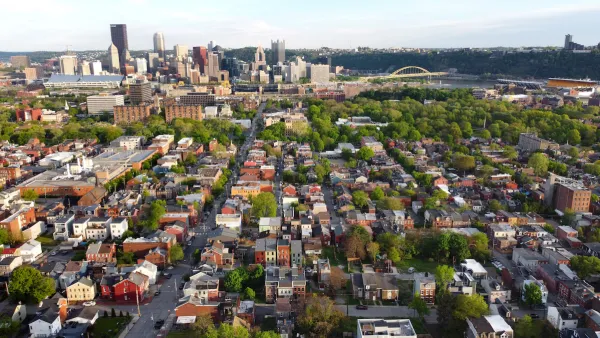
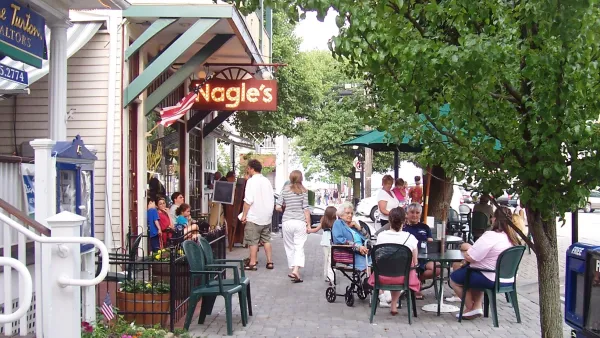
Supporters of New Urbanism may live across the political spectrum, but they all want to live in traditional neighborhoods.
A Better Understanding of Smart Growth Benefits
Smart Growth creates compact, multimodal communities where residents consume less land, drive less, and rely more on non-auto modes. Planners have important stories to tell about the benefits of Smart Growth.
Defining the Buzzword: What's a 15-Minute City?
What does it mean to be a 15-minute city?

Planetizen Federal Action Tracker
A weekly monitor of how Trump’s orders and actions are impacting planners and planning in America.

California plans to bury El Niño’s downpour
If the state plays its cards right, it may be able to store a billion acre-feet of El Niño’s water in aquifers.

Desperate measures: Advocates weigh draining Lake Powell to fill Colorado River
Draining the reservoir could reduce evaporation losses by a couple hundred thousand acre-feet.

Chicago voters approve permanent festival grounds, penalty for vacant property owners
Currently, major summer and fall festivals take over public parks for weeks at a time, drawing criticism from nearby residents

NYC votes to cut outdoor dining red tape, speed up permitting
New York City also voted to allow the Department of Transportation to begin work on urgent projects before notifying elected officials.

California appears to reject Prop. 45
The proposition would have expanded the projects that qualify for a streamlined environmental review, effectively paring down the California Environmental Quality Act.

FREE Course: Walkable City 1: Why Walkability?
After describing his path towards focusing on walkability as the essence of good planning, Jeff Speck marches through his five principal reasons for making more walkable places.
Reinventing Malls: Planning Alchemy—Turning Gray Fields Into Gold
The course focuses on the opportunities and imperatives that shape reinvention of mall sites.

City of Rosemead
Rutgers University, Edward J. Bloustein School of Planning and Public Policy
One Hundred Miles
Hunter College, City University of New York (CUNY)
The Architects Foundation
University of Cincinnati Online
City of Cambridge
Montrose County
The Pocatello Development Authority