Boyd Cohen takes us through a brief tour of the Lion City's many progressive and wildly successful programs, from affordable housing to traffic management and beyond.


For all the unprecedented urban development taking hold of Asia lately, China has a way of hogging the limelight. But the often undercelebrated city-state of Singapore has quite a few programs underway that place it at the forefront of smart cities across the globe, Cohen writes.
With ownership-oriented public housing, unheard-of personal vehicle tax rates (well in excess of 100%), world-class mass rapid transit, leading-edge water management, and high-tech traffic monitoring, the city has quite deservedly earned a reputation in the region for aggressively (and effectively) implementing forward-thinking technologies.
On the flip side, Cohen notes that there's room for improvement: "the culture appears to be quite risk averse... I do not believe Singapore is doing enough to
encourage local innovation to meet the needs of its smart
infrastructure. It appears the bias is much more on tried and true
products from branded multinationals."
But in the end, he concedes that the current state of the city is astonishing, all considered. "Given that it was relatively poor only a few decades ago, it is
impressive to see how Singapore is now a robust, vibrant,
multi-cultural, clean, and safe place to be."
Read the full story: Singapore Is On Its Way To Becoming An Iconic Smart City

Swapping your gas car for an EV is greener than keeping it, research shows
An EV repays the 'carbon debt' caused by building it after 4,400 miles.
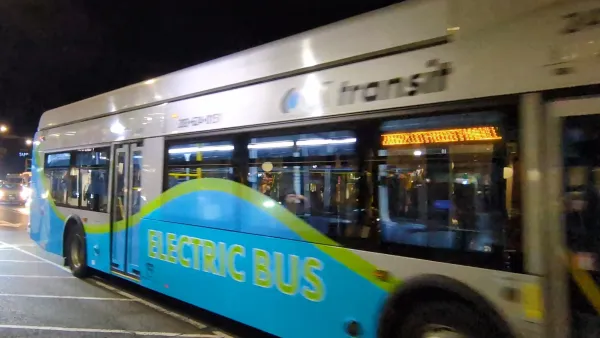
US Transit Fleets Have Bought Over 8,000 Zero-emission Buses
The number of zero-emission transit vehicles grew by 16 percent between 2024 and 2025.

Texas Rural Communities Could Lose Billions From Renewable Energy Tax Credit Cuts
Texas produces more solar and wind energy than anywhere in America — and the tax revenue from it pays for rural schools, hospitals, law enforcement and more. The One Big Beautiful Bill threatens that.

Planetizen Federal Action Tracker
A weekly monitor of how Trump’s orders and actions are impacting planners and planning in America.

California plans to bury El Niño’s downpour
If the state plays its cards right, it may be able to store a billion acre-feet of El Niño’s water in aquifers.

Desperate measures: Advocates weigh draining Lake Powell to fill Colorado River
Draining the reservoir could reduce evaporation losses by a couple hundred thousand acre-feet.

In Texas, data centers are swallowing promised parkland
Residents who moved to Taylor, Texas for a rural community now have to contend with three data centers in their backyard.

How a Chicago-sized wind farm beat the odds and powered on
The project spanned five presidential administrations and a standoff with a U.S. military base.

MTA gives itself 30 days to transform pit into basketball court
The site has been under construction since 2022; the city originally estimated it would finish the court in 2024.

FREE Course: Walkable City 1: Why Walkability?
After describing his path towards focusing on walkability as the essence of good planning, Jeff Speck marches through his five principal reasons for making more walkable places.
Reinventing Malls: Planning Alchemy—Turning Gray Fields Into Gold
The course focuses on the opportunities and imperatives that shape reinvention of mall sites.

City of Rosemead
Rutgers University, Edward J. Bloustein School of Planning and Public Policy
One Hundred Miles
Hunter College, City University of New York (CUNY)
The Architects Foundation
University of Cincinnati Online
City of Cambridge
Montrose County
The Pocatello Development Authority