Ellen Barry reports on the Georgian government's plans for Lazika, "its grandiose city of the future", which will be based on the Chinese concept of the instant city.


Intended to house half a million residents in ten years on what is now a stretch of marshy land near the Black Sea, the hastily started plans for the new city, which were rolled out only four months ago, have drawn mixed reactions in the country, but little real debate.
"Government officials have little time to engage with skeptics. The headlong pace of new construction in Georgia has not allowed for public debate over the projects' financing, environmental impact or merit. Despite queries raised on all of these scores, Lazika's first building - a futuristic Public Service Hall for the new city - is already under construction, and due to open in September. Ten years from now, President Mikheil Saakashvili has said, Lazika will be Georgia's second-largest city after Tbilisi, which has a population of about 1.5 million, and a leading Black Sea trading hub."
"There are so many things that need to be done," says Eka Gigauri of Transparency International. "Why build a totally new city? What stands behind that? There was nothing, no explanation. Just the president said, ‘We are building a new city there.' "
Read the full story: On Black Sea Swamp, Big Plans for Instant City

Major Redevelopment Planned for Gwinnett County, Georgia
City leaders in Norcross, Georgia approved a plan that would bring new housing, retail, and parks to a 'long-neglected' stretch of highway.

Younger, Low Income, Minority Voters Favored Transit in MARTA Referendum
New maps show demographic trends in voting after a March special election to expand MARTA in the Atlanta region.
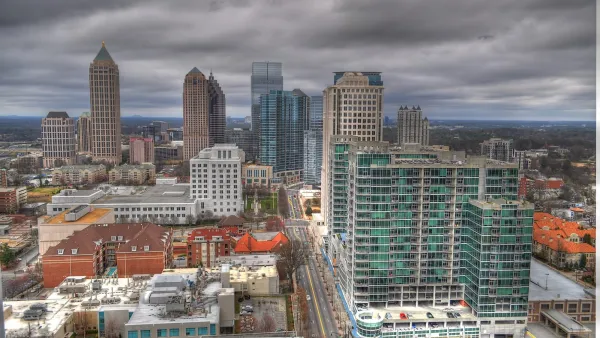
Turning an Atlanta Roadway Into a Shared Street
Atlanta might transform Peachtree Street into a very different kind of public space.

Planetizen Federal Action Tracker
A weekly monitor of how Trump’s orders and actions are impacting planners and planning in America.

California plans to bury El Niño’s downpour
If the state plays its cards right, it may be able to store a billion acre-feet of El Niño’s water in aquifers.

Desperate measures: Advocates weigh draining Lake Powell to fill Colorado River
Draining the reservoir could reduce evaporation losses by a couple hundred thousand acre-feet.

Los Angeles just elected an urban planner as its mayor
Transportation analysts are optimistic that Raman will be more aggressive in addressing transit issues than Bass.

Mamdani’s pied-à-terre tax survives legal challenge
A panel of judges found that the plaintiffs failed to demonstrate injury as a result of New York City's implementation of the tax.

Eastern Nebraska is running out of electricity
Data centers and electrification are straining eastern Nebraska’s grid, throttling economic development.

FREE Course: Walkable City 1: Why Walkability?
After describing his path towards focusing on walkability as the essence of good planning, Jeff Speck marches through his five principal reasons for making more walkable places.
Reinventing Malls: Planning Alchemy—Turning Gray Fields Into Gold
The course focuses on the opportunities and imperatives that shape reinvention of mall sites.

City of Rosemead
Rutgers University, Edward J. Bloustein School of Planning and Public Policy
One Hundred Miles
University of Michigan School for Environment and Sustainability (SEAS)
Hunter College, City University of New York (CUNY)
The Architects Foundation
City of Cambridge
Montrose County
The Pocatello Development Authority