From amongst an international field of distinguished competitors, a 17-memeber team led by James Corner Field Operations has been selected to revamp the Chicago landmark's public spaces, reports Blair Kamin.


According to the Pier's governing board, the famed landscape architecture firm led by James Corner, who co-designed New York's celebrated High Line, was selected because the board, "were impressed by his creative yet practical approach to the proposed revamp."
"In contrast to the grandiose visions of other teams, which called for such features as a towering, glacierlike structure popping out of Lake Michigan and sprawling boardwalks attached to the pier's south end, Corner's group accepted the pier's long, thin contours, but gave it several creative tweaks. Those tweaks include undulating steps that would join the pier's Dock Street promenade to the raised park around its Ferris wheel, plus a striking display of hanging gardens inside the pier's now-bland Crystal Gardens pavilion," writes Kamin.
Corner's winning entry will likely face a serious re-design as only $15 million are believed available for the first phases of the project, and the board suggests "possibly incorporating ideas from the other four design teams who competed for the commission."
Read the full story: Team picked for Navy Pier redesign
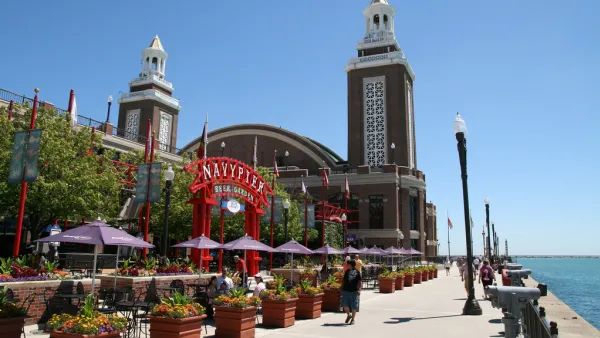
Will Good Design Ruin Navy Pier?
Architecture critic Blair Kamin has an interesting take on the planned $115 revamp of Chicago's top tourist attraction. He wonders if James Corner's "high design" can meld with Navy Pier's "seductive riot of carnival midway tackiness."
Big Ideas Proposed for Chicago's Navy Pier
Blair Kamin reports on proposals from five teams of celebrated designers vying to re-imagine Navy Pier. They reflect big ideas, and big budgets.
Money for Blighted Neighborhoods Pushed to Chicago Tourist Attraction
The administration of Rahm Emanuel okayed a financial scheme to move money for poor neighborhoods into a fund for Navy Pier, a downtown mall and theater.

Planetizen Federal Action Tracker
A weekly monitor of how Trump’s orders and actions are impacting planners and planning in America.

California plans to bury El Niño’s downpour
If the state plays its cards right, it may be able to store a billion acre-feet of El Niño’s water in aquifers.

Desperate measures: Advocates weigh draining Lake Powell to fill Colorado River
Draining the reservoir could reduce evaporation losses by a couple hundred thousand acre-feet.

Mamdani’s pied-à-terre tax survives legal challenge
A panel of judges found that the plaintiffs failed to demonstrate injury as a result of New York City's implementation of the tax.

Eastern Nebraska is running out of electricity
Data centers and electrification are straining eastern Nebraska’s grid, throttling economic development.

Seattle passes record-breaking transit services expansion
Proposition 1 will double the city’s transit tax to add 95,000 more bus trips and preserve 180,000 bus trips annually.

FREE Course: Walkable City 1: Why Walkability?
After describing his path towards focusing on walkability as the essence of good planning, Jeff Speck marches through his five principal reasons for making more walkable places.
Reinventing Malls: Planning Alchemy—Turning Gray Fields Into Gold
The course focuses on the opportunities and imperatives that shape reinvention of mall sites.

City of Rosemead
Rutgers University, Edward J. Bloustein School of Planning and Public Policy
One Hundred Miles
University of Michigan School for Environment and Sustainability (SEAS)
Hunter College, City University of New York (CUNY)
The Architects Foundation
City of Cambridge
Montrose County
The Pocatello Development Authority