Last week, Gov. Jerry Brown announced reforms to the state's Environmental Quality Act that will ease approval for infill development and special projects. Josh Stephens provides the details.


In clarifying guidelines awaited since Senate Bill 226 and Assembly Bill 900 were signed into law late last year, the Office of Planning and Research has drafted reforms to CEQA intended to, "simplify the approval process for infill projects by eliminating repetitive studies of environmental effects already addressed in other planning documents, such as general plans and zoning codes. This will help reduce the time and cost often associated with infill projects, while also allowing cities to focus on new or unique projects that help create jobs, revitalize cities and promote transit."
"Together, CEQA reforms in SB 226 and AB 900 are intended to reduce repetitive documentation and expedite litigation timelines while preserving informed decision-making and mitigation of environmental harm."
Read the full story: Governor Announces CEQA Reforms, per SB 226, AB 900

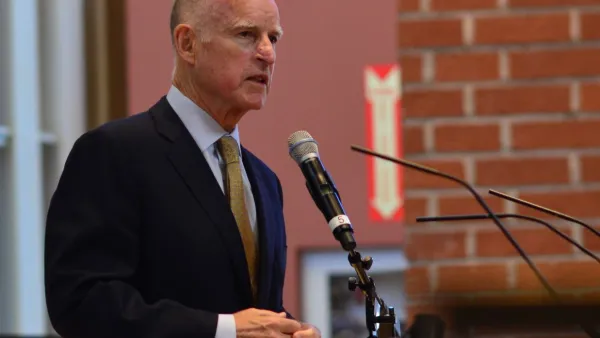
California Governor Jerry Brown Pessimistic on Affordability
Housing often costs a literal fortune in California, and Governor Jerry Brown doesn't see an easy fix. Demand to live in the state is high, but there are local factors at work impeding housing construction.
Compromise Transportation Funding Plan Floated by California Gov. Jerry Brown
With five days left in the legislative season, Gov. Jerry Brown halved the fuels tax increases proposed in the Democratic bill as a sweetener to tax-averse Republicans, though they haven't show any willingness to date to compromise.
At West Coast Climate Pact Signing, Brown Justifies His Support for Fracking
Calif. Gov. Jerry Brown has made climate protection a centerpiece of his policy agenda, yet he has also embraced the controversial technology of fracking to tap his state's huge shale oil reserves by signing SB 4. He explains his position here.

Planetizen Federal Action Tracker
A weekly monitor of how Trump’s orders and actions are impacting planners and planning in America.

‘Going backwards:’ Baltimore mayor, students rally against state's transit funding plan
Maryland's proposed six-year plan provides no funding for Baltimore’s BMORE bus program and reduces its road maintenance funding.

Mamdani sent nearly 6,000 pied-à-terre tax warnings to homes that didn’t qualify
A judge has ordered the administration to cancel thousands of pied-à-terre tax notices after it sent 35% of them erroneously.

Newsom vetoes high-speed rail supervision bill after agency receives condemnatory audit
The audit found the CHSRA approved almost $600,000 in unallowable travel expenses.

Nation sees first electric plane-boat hybrid take off in public demo
The Viceroy Seaglider can fly at speeds of 180mph for up to 180 miles.

One of nation’s poorest counties to receive $6 billion data center
The developers estimate the project will create 200 permanent jobs and 1,000 temporary construction jobs.

FREE Course: Walkable City 1: Why Walkability?
After describing his path towards focusing on walkability as the essence of good planning, Jeff Speck marches through his five principal reasons for making more walkable places.
Reinventing Malls: Planning Alchemy—Turning Gray Fields Into Gold
The course focuses on the opportunities and imperatives that shape reinvention of mall sites.

City of Thousand Oaks
City of Wisconsin Rapids
Harvard University Graduate School of Design
The Architects Foundation
University of Cincinnati Online
Northern Illinois Transit Authority (NITA)
The Pocatello Development Authority
The Urban Renewal Agency of the City of Pocatello