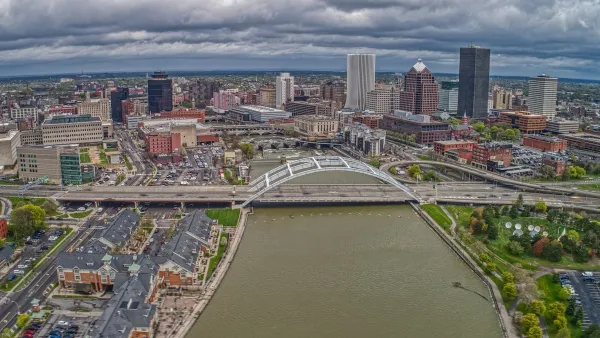
It used to be that Rochester's fortunes were tied to its hometown company, Eastman Kodak. Peter Applebome looks at how the city has managed to avoid the long slide of its famous inhabitant.


With talk of Eastman Kodak's inevitable bankruptcy as its stock price hovers below $1, Applebome's article details the surprising resiliency of what was once the "ultimate company town."
"Rochester has been a job-growth leader in the state in recent years. In 1980, total employment in the Rochester metropolitan area was 414,400. In 2010, it was 503,200. New businesses have been seeded by Kodak's skilled work force, a reminder that a corporation's fall can leave behind not just scars but also things to build upon. "
Despite a bright future for the city, residents feel the pain of nostalgia for a company that provided, "the bountiful jobs that allowed children to follow their parents into Kodak's secure embrace [and] the seemingly endless largess that once allowed the company's founder, George Eastman, to provide dental care at little or no cost to every child in town."
Kodak's slow decline into irrelevance ended up being a blessing however, as it "allowed people at the company and elsewhere to explore new options - to take skills in medical technology, photonics, imaging or optics to small startups or to start their own."
Read the full story: Despite Long Slide by Kodak, Company Town Avoids Decay
Rochester Approves Tenant Protections
The city adopted the strictest possible version of New York state’s ‘Good Cause’ eviction protections, which cap rent increases at 10 percent.
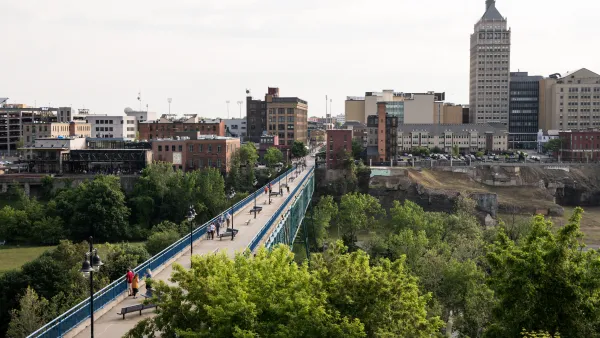
Book Excerpt: Rochester, New York’s Forgotten Subway
Did you know Rochester, New York, once had a subway? This book excerpt tells the story, complete with a custom map, of the only city in the world to build a subway and then close it.
Rochester Shows Possible Future for Former Highways
A former freeway is undergoing a massive redevelopment that goes beyond highway removal to reconnect and revitalize surrounding areas.

Planetizen Federal Action Tracker
A weekly monitor of how Trump’s orders and actions are impacting planners and planning in America.

California plans to bury El Niño’s downpour
If the state plays its cards right, it may be able to store a billion acre-feet of El Niño’s water in aquifers.

Desperate measures: Advocates weigh draining Lake Powell to fill Colorado River
Draining the reservoir could reduce evaporation losses by a couple hundred thousand acre-feet.

Chicago voters approve permanent festival grounds, penalty for vacant property owners
Currently, major summer and fall festivals take over public parks for weeks at a time, drawing criticism from nearby residents

NYC votes to cut outdoor dining red tape, speed up permitting
New York City also voted to allow the Department of Transportation to begin work on urgent projects before notifying elected officials.

California appears to reject Prop. 45
The proposition would have expanded the projects that qualify for a streamlined environmental review, effectively paring down the California Environmental Quality Act.

FREE Course: Walkable City 1: Why Walkability?
After describing his path towards focusing on walkability as the essence of good planning, Jeff Speck marches through his five principal reasons for making more walkable places.
Reinventing Malls: Planning Alchemy—Turning Gray Fields Into Gold
The course focuses on the opportunities and imperatives that shape reinvention of mall sites.

City of Rosemead
Rutgers University, Edward J. Bloustein School of Planning and Public Policy
One Hundred Miles
Hunter College, City University of New York (CUNY)
The Architects Foundation
University of Cincinnati Online
City of Cambridge
Montrose County
The Pocatello Development Authority