Automated monorails were the hottest invention since the wheel back in the 1960s, and the Feds wanted to see them in every city. So what happened?


Eric Jaffe says that HUD actually released a report in 1964, under the direction of President Lyndon B. Johnson, to promote alternative forms of transportation. After failing to catch on, Congress recommended making funds available to cities to encourage the construction of more monorails. Jaffe says there was interest, and a handful of cities got theirs built, but the Reagan Administration brought the grants to an end:
"Still, the legacy of the downtown people mover is not entirely a failed one, civil engineers William Sproule and William Leder argued in a recent talk. In some sense, it cleared the way for the surge in circulator buses and streetcars taking place today."
Read the full story: Whatever Happened to the Downtown People Mover?


‘The Power of the Kraken:’ Seattle Monorail Ridership Spikes for Hockey Games
Seattle’s new professional hockey team is drawing legions of enthusiastic fans. Around a quarter of them are taking public transit, such as the city’s often-maligned monorail, to games.
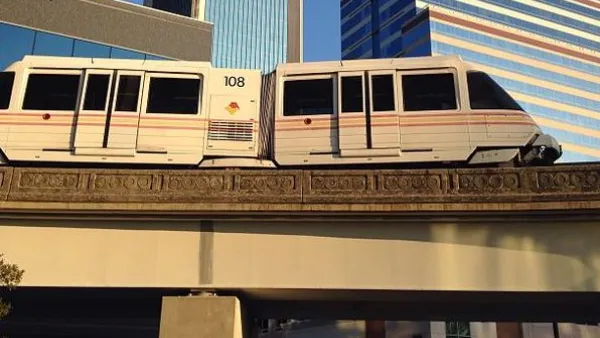
Jacksonville To Replace Monorail With Autonomous Shuttles
The city’s aging monorail system will be repurposed as part of an expanded 10-mile shuttle system.
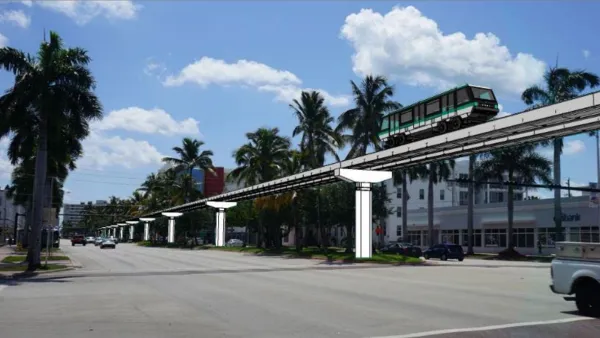
Miami Rapid Transit Project Moves Forward
The county completed the draft environmental impact study for a monorail and people mover planned as part of its rapid transit system.

Planetizen Federal Action Tracker
A weekly monitor of how Trump’s orders and actions are impacting planners and planning in America.

Amtrak, CN end decades-long dispute with eight-year agreement
The new operating agreement establishes an updated framework for the companies to work together, including processes to resolve disputes.

Judges permit Denver to divert 77,000 acre feet from the Colorado River for reservoir expansion
Overuse and climate change have caused the Colorado River’s water levels to plummet.

NYC DOT wants faster, more permanent street upgrades
The city is examining ways to build more concrete infrastructure without getting entangled in 'decades-long' projects.

'Something we’ve never seen before:' rising utility rates could strain city finances nationwide
Data centers, climate change and other factors have caused utility rates in the United States to increase by 38% since 2020.

Trump to overrule local leaders, lease millions of acres of America’s Pacific Island territories’ seafloors to mining companies
International law says that the Indigenous people of America’s territories have a right to prior and informed consent regarding projects that impact their countries.

FREE Course: Walkable City 1: Why Walkability?
After describing his path towards focusing on walkability as the essence of good planning, Jeff Speck marches through his five principal reasons for making more walkable places.
Reinventing Malls: Planning Alchemy—Turning Gray Fields Into Gold
The course focuses on the opportunities and imperatives that shape reinvention of mall sites.

Harvard University Graduate School of Design
KFH Group Inc.
Greater Baltimore Committee
The Architects Foundation
University of Cincinnati Online
The Pocatello Development Authority
The Urban Renewal Agency of the City of Pocatello