Blair Kamin uses Columbus, Ohio's retail development on the Cap at Union Station as a success story. What can Chicago learn from this design strategy that at once addresses economic development and the enrichment of the cityscape?


"A case study by a real estate developers group, the Washington-based Urban Land Institute, said the cap shows that the following ingredients are necessary: an active road reconstruction project, well-organized citizens, an eager developer, a city government that makes the project a priority and a strong retail environment.
Today, however, Chicago and other cities have an oversupply of retail space.
No matter how replicable a model it turns out to be, the Cap at Union Station expands our ideas of what freeway lids can be. Even parks over freeways could benefit from the presence of restaurants and shops, in the view of developer Lucks."
Read the full story: Ohio highway cap at forefront of urban design trend; retail complex atop Columbus expressway offers model for Chicago

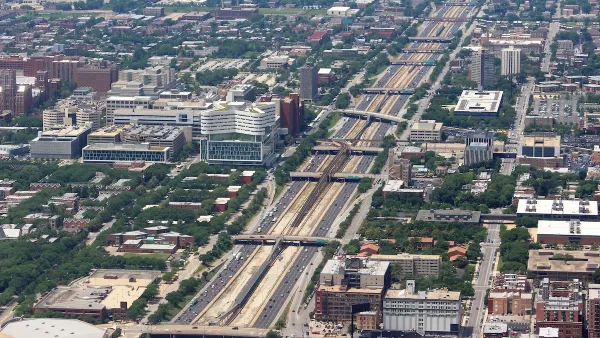
Chicago Awarded $2M Reconnecting Communities Grant
Community advocates say the city’s plan may not do enough to reverse the negative impacts of a major expressway.
Chicago's Lake Shore Drive Renamed to Honor Black Pioneer
Introducing Jean Baptiste Point DuSable Lake Shore Drive, renamed to honor the first non-indigenous settler of Chicago.
Chicago Needs Congestion Pricing
The Chicago Tribune's editorial board argues that congestion pricing will not only decrease congestion, but also make the city more attractive to people and businesses.

Planetizen Federal Action Tracker
A weekly monitor of how Trump’s orders and actions are impacting planners and planning in America.

Amtrak, CN end decades-long dispute with eight-year agreement
The new operating agreement establishes an updated framework for the companies to work together, including processes to resolve disputes.

Judges permit Denver to divert 77,000 acre feet from the Colorado River for reservoir expansion
Overuse and climate change have caused the Colorado River’s water levels to plummet.

NYC DOT wants faster, more permanent street upgrades
The city is examining ways to build more concrete infrastructure without getting entangled in 'decades-long' projects.

'Something we’ve never seen before:' rising utility rates could strain city finances nationwide
Data centers, climate change and other factors have caused utility rates in the United States to increase by 38% since 2020.

Trump to overrule local leaders, lease millions of acres of America’s Pacific Island territories’ seafloors to mining companies
International law says that the Indigenous people of America’s territories have a right to prior and informed consent regarding projects that impact their countries.

FREE Course: Walkable City 1: Why Walkability?
After describing his path towards focusing on walkability as the essence of good planning, Jeff Speck marches through his five principal reasons for making more walkable places.
Reinventing Malls: Planning Alchemy—Turning Gray Fields Into Gold
The course focuses on the opportunities and imperatives that shape reinvention of mall sites.

Harvard University Graduate School of Design
KFH Group Inc.
Greater Baltimore Committee
The Architects Foundation
University of Cincinnati Online
The Pocatello Development Authority
The Urban Renewal Agency of the City of Pocatello