South Carolina members of the Urban Land Institute met in Columbia, South Carolina to offer suggestions for overhauling Assembly Street, a major downtown thoroughfare that separates distinct areas of the urban core.


The land institute's experts said the intersection of Assembly and Gervais streets is one of the most important, if not the most important intersection in the state. With the State House to the southeast, the Capitol Center – which houses the S.C. Department of Commerce – and Main Street to the northeast, and the Congaree Vista warehouse district to the west, it is crossed by not only every mover and shaker in the state, but also the nation when they come to do business here, the experts said.
But the experts described the 125-foot wide street as a daunting "psychological moat" that separates a resurgent Main Street from the bustling Congaree Vista warehouse district, and the University of South Carolina's central campus from its emerging Innovista research campus. Most city streets are 60 feet wide.
Panelists said the intersection should be transformed into an "urban moment" with public art, a water feature or a linear park created by narrowing the street to four lanes and widening and landscaping its median.
Read the full story: Plan reinvents Assembly Street

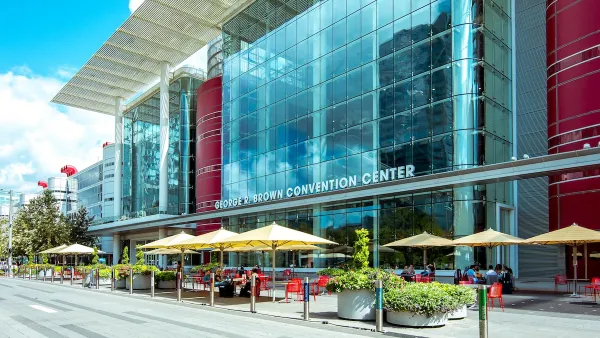
Houston 'Abandons' Street for Convention Center Expansion
The city plans to eliminate multiple blocks of public streets as part of an expansion project that some residents say didn’t take into account local connectivity.

Columbia’s Revitalized ‘Loop’ Is a Hub for Local Entrepreneurs
A focus on small businesses is helping a commercial corridor in Columbia, Missouri thrive.

Redesigning Streets for Livability: A Global View
An excerpt from the introduction of the recent book, “Streets For All: 50 Strategies for Shaping Resilient Cities,” edited by Vinayak Bharne and Shyam Khandekar.

Planetizen Federal Action Tracker
A weekly monitor of how Trump’s orders and actions are impacting planners and planning in America.

California plans to bury El Niño’s downpour
If the state plays its cards right, it may be able to store a billion acre-feet of El Niño’s water in aquifers.

Chicago breaks ground on $3 billion megadevelopment
The new neighborhood, titled Foundry Park, will one day host 3,700 residences.

California High-Speed Rail Authority CEO resigns after $600,000 scandal
Under Ian Choudri, the authority used taxpayer dollars to fund first class flights and trips to nightclubs.

Want to study the Missouri River? Soon, you may need unanimous approval from 10 states
Legislation would require 10 governors’ permission to study or build projects moving water outside the basin.

Desperate measures: Advocates weigh draining Lake Powell to fill Colorado River
Draining the reservoir could reduce evaporation losses by a couple hundred thousand acre-feet.

FREE Course: Walkable City 1: Why Walkability?
After describing his path towards focusing on walkability as the essence of good planning, Jeff Speck marches through his five principal reasons for making more walkable places.
Reinventing Malls: Planning Alchemy—Turning Gray Fields Into Gold
The course focuses on the opportunities and imperatives that shape reinvention of mall sites.

City of Rosemead
Rutgers University, Edward J. Bloustein School of Planning and Public Policy
One Hundred Miles
Hunter College, City University of New York (CUNY)
The Architects Foundation
University of Cincinnati Online
City of Cambridge
Montrose County
The Pocatello Development Authority