Once again, a government shutdown looms after Sept. 30 over funding for disaster relief. House Republicans insist that the additional spending must be off-set with spending cuts, and their target is a subsidy for electric cars and batteries.


It goes by the name, "Advanced Technology Vehicles Manufacturing (ATVM) program", established by President Bush with bipartisan approval in 2007, but you could just as easily call it a retooling program for electric and fuel-efficient cars.
House Republicans insist that to pay for the recent disaster relief, $1.5 billion must be taken from this program. If the Senate doesn't agree, another government shut-down looms on Sept. 30.
"These retooling loans made it possible for Ford Motor Co. to save 1,900 jobs at their Michigan Assembly Plant in Wayne, Mich., so they could build the all-new Ford Focus electric and the battery-electric Focus in America," said Democratic Sen. Debbie Stabenow, who represents Michigan.
Ford officials say 11 plants in five states benefited from the program. The company even moved a hybrid battery facility from Mexico to Michigan to take advantage of it."
DOE attributes almost 40,000 jobs - either saved or created, due to the loan program.
From Dept. of Energy - ATVM: "The FY 2009 Continuing Resolution (CR) enacted on September 30, 2008, appropriated $7.5 billion to support a maximum of $25 billion in loans under the ATVM Loan Program."
Read the full story: The New Standoff: Clean-Car Jobs Vs. Disaster Relief

AirBnb Commits Empty Los Angeles Listings for Emergency Housing Within 24 Hours of Future Disasters
The company’s nonprofit arm formalized an agreement to offer free housing to residents after disasters.
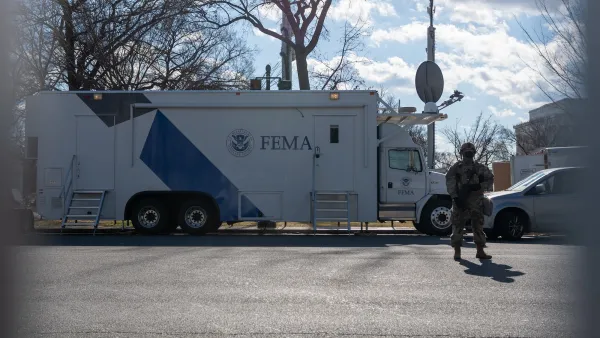
Judge Says FEMA Can’t Withhold Grant Funds Under ‘Arbitrary and Capricious’ Conditions
The decision favors a coalition of 12 states that sued the Trump administration over new conditions for disaster recovery and emergency relief funds.

The 120 Year Old Tiny Home Villages That Sheltered San Francisco’s Earthquake Refugees
More than a century ago, San Francisco mobilized to house thousands of residents displaced by the 1906 earthquake. Could their strategy offer a model for the present?

Planetizen Federal Action Tracker
A weekly monitor of how Trump’s orders and actions are impacting planners and planning in America.

California plans to bury El Niño’s downpour
If the state plays its cards right, it may be able to store a billion acre-feet of El Niño’s water in aquifers.

Desperate measures: Advocates weigh draining Lake Powell to fill Colorado River
Draining the reservoir could reduce evaporation losses by a couple hundred thousand acre-feet.

Chicago voters approve permanent festival grounds, penalty for vacant property owners
Currently, major summer and fall festivals take over public parks for weeks at a time, drawing criticism from nearby residents

NYC votes to cut outdoor dining red tape, speed up permitting
New York City also voted to allow the Department of Transportation to begin work on urgent projects before notifying elected officials.

California appears to reject Prop. 45
The proposition would have expanded the projects that qualify for a streamlined environmental review, effectively paring down the California Environmental Quality Act.

FREE Course: Walkable City 1: Why Walkability?
After describing his path towards focusing on walkability as the essence of good planning, Jeff Speck marches through his five principal reasons for making more walkable places.
Reinventing Malls: Planning Alchemy—Turning Gray Fields Into Gold
The course focuses on the opportunities and imperatives that shape reinvention of mall sites.

City of Rosemead
Rutgers University, Edward J. Bloustein School of Planning and Public Policy
One Hundred Miles
Hunter College, City University of New York (CUNY)
The Architects Foundation
University of Cincinnati Online
City of Cambridge
Montrose County
The Pocatello Development Authority