San Francisco has made steps to avert cars from Market Street, but the next steps to alleviate congestion are vague. A gradual rollout of trial experiments to gauge a method's success seems the most likely answer, reports Rachel Gordon.


Board of Supervisors President David Chu, who is also running for San Francisco mayor in November, spoke about what Market Street could be.
"'A viable vision for the future of Market Street is of a world-class avenue drawing its success from the huge number of people it attracts through transit and taxis, and on foot and bicycle, and no private automobiles other than delivery vehicles,' said Chiu, who proposed legislation Tuesday urging transportation officials to move forward with more trial programs."
Ken Cleaveland, director of government and public affairs for the Building Owners and Managers Association of San Francisco, said a gradual approach of testing possible solutions for their effectiveness before they are put into practice.
"He's opposed to a ban on private cars on Market Street but said experimenting with changes and studying their impact makes sense. The fear that some in the business community had about the forced turns evaporated once the changes were implemented."
Read the full story: S.F. taking small steps to unclog Market Street
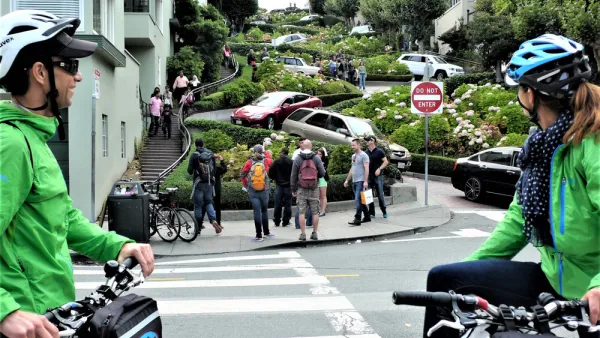
Social Equity Cited in Veto of California Road Pricing Bill
Gov. Gavin Newsom vetoed a unique road pricing bill due to concerns that charging a fee would limit access to driving on two blocks of Lombard Street, a popular tourist attraction in San Francisco that is severely congested.
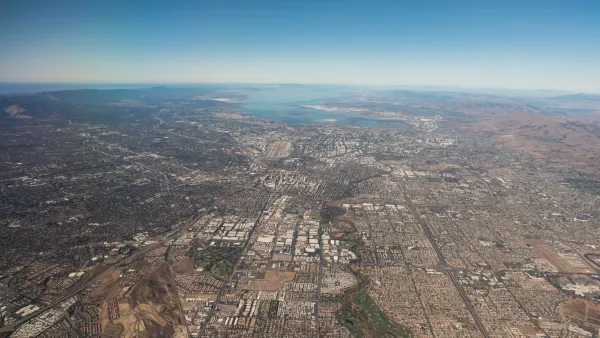
Silicon Valley Isn't Really Over
Though a handful of recent articles predicted "peak Silicon Valley," new numbers show the region is still producing lots of good jobs and attracting plenty of venture capital.
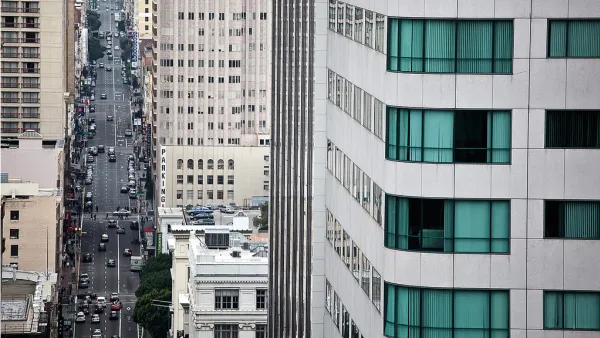
Who Should Pay for Congestion in Booming San Francisco?
Facing record-level population growth and a booming job market, the city of San Francisco wants luxury developers to pay into the public transit system.

Planetizen Federal Action Tracker
A weekly monitor of how Trump’s orders and actions are impacting planners and planning in America.

California plans to bury El Niño’s downpour
If the state plays its cards right, it may be able to store a billion acre-feet of El Niño’s water in aquifers.

Desperate measures: Advocates weigh draining Lake Powell to fill Colorado River
Draining the reservoir could reduce evaporation losses by a couple hundred thousand acre-feet.

Mamdani’s pied-à-terre tax survives legal challenge
A panel of judges found that the plaintiffs failed to demonstrate injury as a result of New York City's implementation of the tax.

Eastern Nebraska is running out of electricity
Data centers and electrification are straining eastern Nebraska’s grid, throttling economic development.

Seattle passes record-breaking transit services expansion
Proposition 1 will double the city’s transit tax to add 95,000 more bus trips and preserve 180,000 bus trips annually.

FREE Course: Walkable City 1: Why Walkability?
After describing his path towards focusing on walkability as the essence of good planning, Jeff Speck marches through his five principal reasons for making more walkable places.
Reinventing Malls: Planning Alchemy—Turning Gray Fields Into Gold
The course focuses on the opportunities and imperatives that shape reinvention of mall sites.

City of Rosemead
Rutgers University, Edward J. Bloustein School of Planning and Public Policy
One Hundred Miles
University of Michigan School for Environment and Sustainability (SEAS)
Hunter College, City University of New York (CUNY)
The Architects Foundation
City of Cambridge
Montrose County
The Pocatello Development Authority