Philadelphia is opening its first "parklet" -- a small public park space built on street parking spaces.


It's part of a larger trend in cities like New York and San Francisco to quickly and cheaply create new public spaces.
"Philadelphia has long been eager to get in on the act, but wasn't quite sure where to put a pilot parklet, said Rina Cutler, deputy mayor for transportation. The University City District solved the problem by volunteering this summer to serve as a guinea pig.
'We're hoping this parklet becomes an attraction and people will want to hang out there,' said Andrew Stober, who works for Cutler in the Mayor's Office of Transportation and Utilities. The parklet is across from a busy trolley stop.
Parklets are the newest tool in a kit of low-cost amenities that cities have been using to make urban living more pleasant and to encourage people to linger on the sidewalks. Like bike lanes and farmers' markets, they're cheap and easy to install. Philadelphia's parklet cost $10,000 and was financed entirely by the William Penn Foundation."
Read the full story: Transforming parking spots to parklets: Philadelphia joins an urban trend
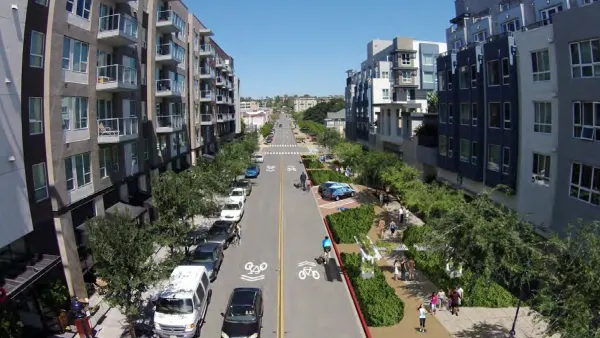
San Diego Swaps Parking Lane for Kid-Friendly Mini Park
The block-long greenway will feature interactive play equipment and landscaping.
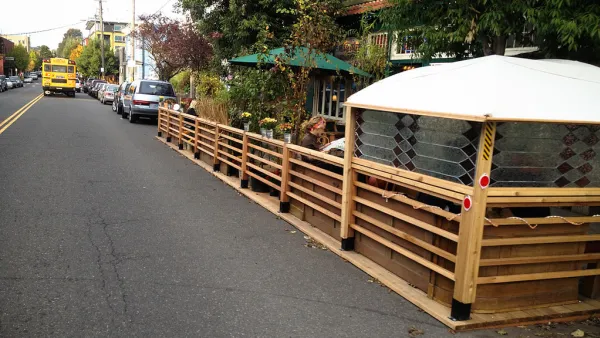
The Economic Case for Converting Parking to Parklets
Emily Badger of The Washington Post Wonkblog writes about a new study showing the economic benefits of converting street spaces in front of storefronts to parklets. Other options for street spaces include bike lanes, bikeshare docks, and bus lanes.
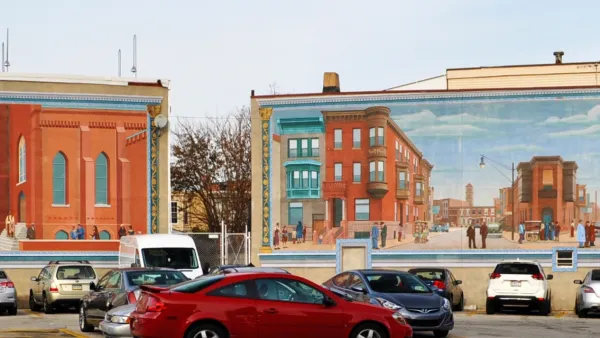
Philadelphia's downtown parking lots are a 'valuable, untapped resource'
Over two dozen city-owned parking lots could be developed into housing or other uses.

Planetizen Federal Action Tracker
A weekly monitor of how Trump’s orders and actions are impacting planners and planning in America.

Eastern Nebraska is running out of electricity
Data centers and electrification are straining eastern Nebraska’s grid, throttling economic development.

Washington state to charge fee to drivers with fuel-efficient cars
Revenue from the fee will go towards supporting the state’s highways.

Instead of building new housing, LA developers are turning mansions into mega-mansions
In the richest areas, the number of houses valued at $30 million with demolition permits has skyrocketed since 2018.

Illinois considers spending $1 billion in taxpayer money on data center
A quantum computing campus and data center are currently under construction in Chicago.

As development costs rise, Boston moves to lessen affordable housing requirements
The Boston Zoning Commission and the City Council still need to approve Boston Mayor Michelle Wu’s proposed changes

FREE Course: Walkable City 1: Why Walkability?
After describing his path towards focusing on walkability as the essence of good planning, Jeff Speck marches through his five principal reasons for making more walkable places.
Reinventing Malls: Planning Alchemy—Turning Gray Fields Into Gold
The course focuses on the opportunities and imperatives that shape reinvention of mall sites.

City of Charlotte
City of Rosemead
Rutgers University, Edward J. Bloustein School of Planning and Public Policy
University of Michigan School for Environment and Sustainability (SEAS)
Hunter College, City University of New York (CUNY)
The Architects Foundation
University District Partnership
City of Cambridge
The Pocatello Development Authority