A new report published by the Carnegie Endowment for International Peace proposes, among other things, a 5%-per-barrel tax on petro and the creation of the National Infrastructure Bank to cope with transportation budget cuts.


Former Senator Bill Bradley, former Secretary of Homeland Security Tom Ridge, and former Comptroller General of the Government Accountability Office David Walker authored a 129-page plan titled "Road to Recovery: Transforming America's Transportation." In it, the Democrat-Republican-Independent trio broach many urgent issues pertinent to America's transportation infrastructure, including the dwindling National Highway Trust, deficit spending, and rampant earmarks.
Daniel Ferry observes, "The centerpiece of the plan is a bold proposal to levy a tax on oil at the point of production or importation, and put a corresponding tax on fuel sold to consumers at the pump. [...] The tax burden, therefore, falls both on oil companies and gasoline consumers, and stabilizes the price of fuel at the pump within a narrow range."
Carnegie Endowment for International Peace is a nonpartisan global think tank founded in 1910.
Read the full story: Carnegie Endowment Releases Plan to Reform Transportation Funding
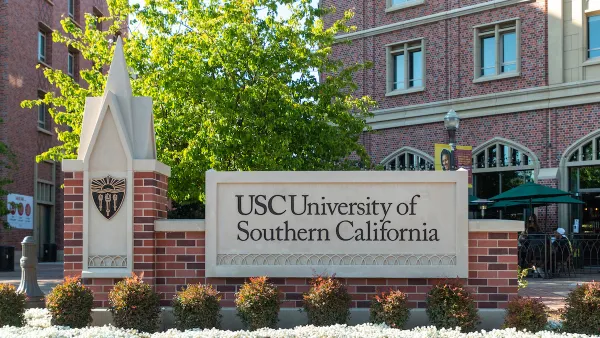
Sustainability Expert Becomes Dean of USC’s School of Public Policy
Chris Boone, a sustainability leader, becomes dean of the USC Price School of Public Policy, where he aims to advance interdisciplinary solutions and sustainability initiatives while building on the school’s legacy of public policy leadership.
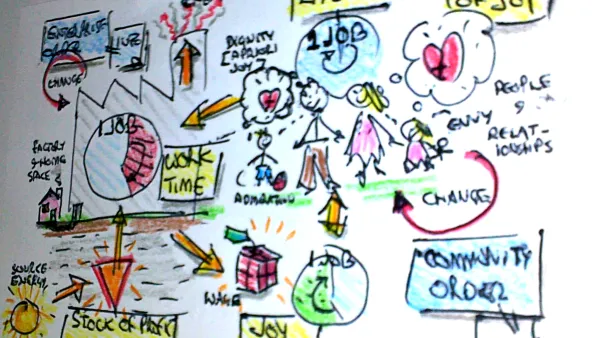
APA Releases its First Guide to Equity
The American Planning Association (APA) makes a clear statement that planners are especially suited to address matters of social equity.
Cities' Role in Climate Governance and Global Policy: A Dispatch from the Urban20
In a dispatch from the Urban 20 Mayoral Summit, Jocelyn Perry and Bill Burke-White write about cities' role in climate governance and public policy.

Planetizen Federal Action Tracker
A weekly monitor of how Trump’s orders and actions are impacting planners and planning in America.

Eastern Nebraska is running out of electricity
Data centers and electrification are straining eastern Nebraska’s grid, throttling economic development.

Study reveals best places in the U.S. for cycling, walking
New research from Streetlight Data examines bicycle and pedestrian miles per capita in the 100 largest U.S. cities by population.

DSA members accuse Mamdani of 'abandoning values' over housing redevelopment
New York City's mayor plans to replace about 2,000 units of public housing with private, mixed-income housing.

All sides of BRT debate unhappy with CDOT’s most recent move
The Colorado Department of Transportation is no longer considering center-running bus lanes for Colorado Boulevard.

Massachusetts bogs generate both power, and cranberries
Putting solar panels above farmland is one way Massachusetts is advancing toward its goal of net-zero carbon emissions by 2050.

FREE Course: Walkable City 1: Why Walkability?
After describing his path towards focusing on walkability as the essence of good planning, Jeff Speck marches through his five principal reasons for making more walkable places.
Reinventing Malls: Planning Alchemy—Turning Gray Fields Into Gold
The course focuses on the opportunities and imperatives that shape reinvention of mall sites.

City of Rosemead
Rutgers University, Edward J. Bloustein School of Planning and Public Policy
One Hundred Miles
University of Michigan School for Environment and Sustainability (SEAS)
Hunter College, City University of New York (CUNY)
The Architects Foundation
City of Cambridge
The Pocatello Development Authority
The Urban Renewal Agency of the City of Pocatello