Urban parks have an important role to play in solving the health and fitness crisis, but too many acres of parkland are not helping people become healthier. How can park systems be designed to be better-used and live up to their potential?


The Trust for Public Land has released a report, detailing numerous ways in which the park system can maximize their contributions to the health of individuals. Many urban parks make it too difficult to exercise, whether they are uninviting, confusing, or simply don't offer enough choices for activity.
Peter Harnik and Coleen Gentles write, "Even if parks didn't provide all the urban benefits they are known for -- improving the environment, attracting tourists, building community, enhancing property values -- they'd still be critically important because of their potential contribution to public health and wellness. But platitudes about healthy parks aren't enough. If park agencies are to truly justify all the land and tax money they use, they must actually serve their health functions as powerfully as do doctors, hospitals, and health agencies."
Some specific strategies for achieving this goal include adding running and jogging trails around golf courses, adding fitness zones adjacent to playgrounds so that adults can exercise while kids play, and ensuring a balance between unstructured open space and specialized athletic complexes.
Thanks to Ryan Donahue
Read the full story: Hey, city parks, it's time to get into better shape
Sustainable Urban Design: A New Tool and Approach on The Talking Headways Podcast
Discover how the Sustainable Urban Design Framework helps planners create livable, sustainable communities. Nico Larco from the University of Oregon explores a new tool and book in the latest “Talking Headways” podcast.
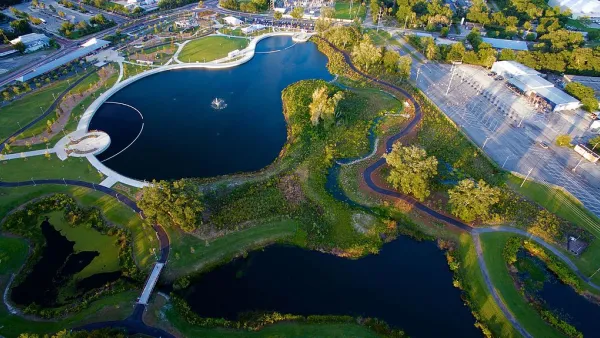
Gainesville Turns Abandoned Industrial Hub Into Innovative Park
Gainesville turns contaminated land into a contemporary public greenspace to serve as the city's “Central Park."
Improving Mental Health May Be As Easy As a Walk in the Park
A new study offers evidence that walking in a natural setting is more beneficial to mental health than walking in an urban setting.

Planetizen Federal Action Tracker
A weekly monitor of how Trump’s orders and actions are impacting planners and planning in America.

California plans to bury El Niño’s downpour
If the state plays its cards right, it may be able to store a billion acre-feet of El Niño’s water in aquifers.

Desperate measures: Advocates weigh draining Lake Powell to fill Colorado River
Draining the reservoir could reduce evaporation losses by a couple hundred thousand acre-feet.

Los Angeles just elected an urban planner as its mayor
Transportation analysts are optimistic that Raman will be more aggressive in addressing transit issues than Bass.

Mamdani’s pied-à-terre tax survives legal challenge
A panel of judges found that the plaintiffs failed to demonstrate injury as a result of New York City's implementation of the tax.

Eastern Nebraska is running out of electricity
Data centers and electrification are straining eastern Nebraska’s grid, throttling economic development.

FREE Course: Walkable City 1: Why Walkability?
After describing his path towards focusing on walkability as the essence of good planning, Jeff Speck marches through his five principal reasons for making more walkable places.
Reinventing Malls: Planning Alchemy—Turning Gray Fields Into Gold
The course focuses on the opportunities and imperatives that shape reinvention of mall sites.

City of Rosemead
Rutgers University, Edward J. Bloustein School of Planning and Public Policy
One Hundred Miles
University of Michigan School for Environment and Sustainability (SEAS)
Hunter College, City University of New York (CUNY)
The Architects Foundation
City of Cambridge
Montrose County
The Pocatello Development Authority