A new book looks into the history of the transcontinental railroads and how the corrupt connection between politics and business helped spread the American economy to the West.


NPR talks with historian Richard White about his new book, "Railroaded", which looks at how the corporations behind transcontinental railroads and how those businesses largely dictated how the growing American economy and its western cities took shape.
"'Western railroads, particularly the transcontinental railroads, would not have been built without public subsidies, without the granting of land and, more important than that, loans from the federal government ... because there is no business [in the West at that time,] there is absolutely no reason to build [railroads] except for political reasons and the hope that business will come.'
'What we're talking about is 1,500 or more miles between the Missouri River and California, in which there are virtually no Anglo-Americans. Most railroad men look at this, including [railroad magnate Cornelius] Vanderbilt, and they want nothing to do with it.'"
Read the full story: How Trains 'Railroaded' The American Economy

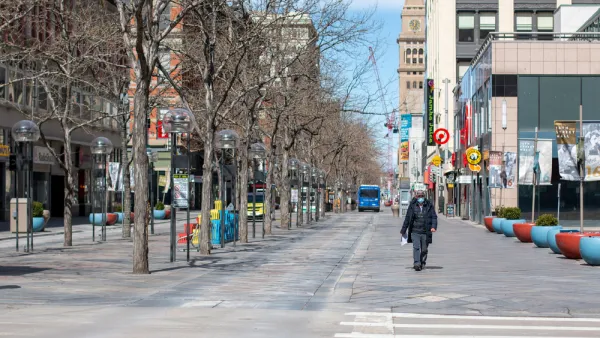
COVID: Colorado Activates Partial Crisis Standards of Care
In a sign that the pandemic is far from over, Colorado reactivated its crisis standards of care for staffing of health care systems on Nov. 9 as infections increased modestly nationwide. Gov. Polis made all vaccinated adults eligible for a booster.
Green Hydrogen, Plus Storage, Key to Los Angeles' Plan for Carbon-Free Electricity
The Los Angeles municipal utility will convert a Utah coal power plant to run on natural gas in 2025. According to a proposal unveiled Dec. 10, the plant will incrementally be converted to run entirely on hydrogen, a zero-emission fuel, by 2045.
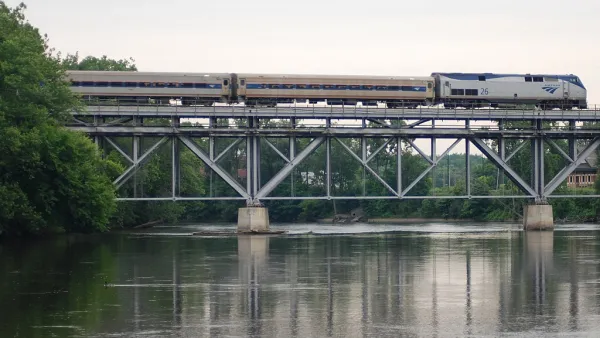
Amtrak Wants to Extend the Wolverine Line With Service From Detroit to Toronto
There hasn't been a passenger rail connection between Detroit and Toronto since 1971, but that could change.

Planetizen Federal Action Tracker
A weekly monitor of how Trump’s orders and actions are impacting planners and planning in America.

Amtrak, CN end decades-long dispute with eight-year agreement
The new operating agreement establishes an updated framework for the companies to work together, including processes to resolve disputes.

Judges permit Denver to divert 77,000 acre feet from the Colorado River for reservoir expansion
Overuse and climate change have caused the Colorado River’s water levels to plummet.

NYC DOT wants faster, more permanent street upgrades
The city is examining ways to build more concrete infrastructure without getting entangled in 'decades-long' projects.

'Something we’ve never seen before:' rising utility rates could strain city finances nationwide
Data centers, climate change and other factors have caused utility rates in the United States to increase by 38% since 2020.

Trump to overrule local leaders, lease millions of acres of America’s Pacific Island territories’ seafloors to mining companies
International law says that the Indigenous people of America’s territories have a right to prior and informed consent regarding projects that impact their countries.

FREE Course: Walkable City 1: Why Walkability?
After describing his path towards focusing on walkability as the essence of good planning, Jeff Speck marches through his five principal reasons for making more walkable places.
Reinventing Malls: Planning Alchemy—Turning Gray Fields Into Gold
The course focuses on the opportunities and imperatives that shape reinvention of mall sites.

Harvard University Graduate School of Design
KFH Group Inc.
Greater Baltimore Committee
The Architects Foundation
University of Cincinnati Online
The Pocatello Development Authority
The Urban Renewal Agency of the City of Pocatello