Plans to revive a decades-dead streetcar loop in St. Louis are gathering steam.


"Edwards, who is best known for his Blueberry Hill restaurant-nightclub and for helping to reinvigorate the Delmar Loop, is considered the father of the planned Loop streetcar comeback. He has proposed and won the support of regional and federal backers for an electric hybrid version of colorful old St. Louis electric streetcars that used to travel up and down the Delmar Loop and to Forest Park. The last fixed-track trolleys ran in St. Louis in 1966.
The route would run from near the Lion Gates at Trinity Avenue in University City to DeBaliviere Avenue in St. Louis, and then south to Forest Park and back, traveling with car traffic. The trolleys would circle the Missouri Historical Society and a roundabout at Trinity.
The project is not without critics. Some people question whether trolley projects are a good use of federal money. Others worry about traffic congestion and the inconvenience of construction."
The $43 million project could begin construction early next year and open by 2013.
Read the full story: University City Loop trolley moves forward
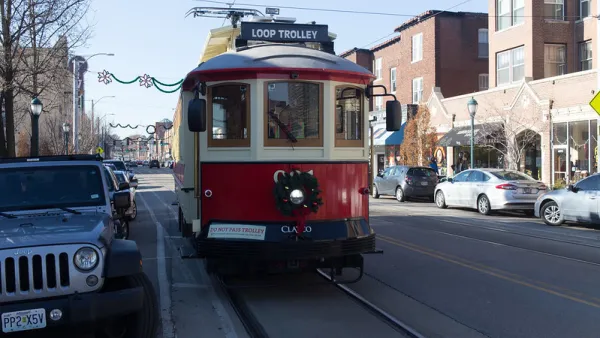
Loop Trolley on the Ropes in St. Louis
Extremely poor ridership might be dooming the St. Louis Loop Trolley less than a year after it opened to the public.
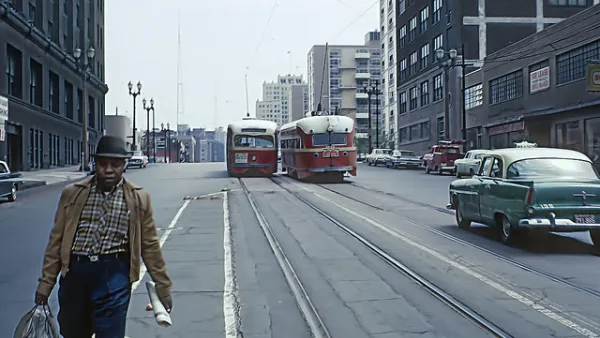
St. Louis Trolley Plans Hit a Snag
The St. Louis trolley revival is running out of cash.
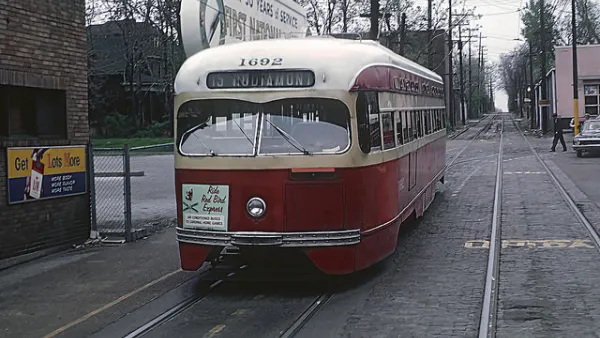
St. Louis Trolley Hoping to Increase Hours
The St. Louis Trolley should begin operating later this year, but planners are hoping for additional funding to allow the service to operate longer hours.

Planetizen Federal Action Tracker
A weekly monitor of how Trump’s orders and actions are impacting planners and planning in America.

California plans to bury El Niño’s downpour
If the state plays its cards right, it may be able to store a billion acre-feet of El Niño’s water in aquifers.

Desperate measures: Advocates weigh draining Lake Powell to fill Colorado River
Draining the reservoir could reduce evaporation losses by a couple hundred thousand acre-feet.

Los Angeles just elected an urban planner as its mayor
Transportation analysts are optimistic that Raman will be more aggressive in addressing transit issues than Bass.

Mamdani’s pied-à-terre tax survives legal challenge
A panel of judges found that the plaintiffs failed to demonstrate injury as a result of New York City's implementation of the tax.

Eastern Nebraska is running out of electricity
Data centers and electrification are straining eastern Nebraska’s grid, throttling economic development.

FREE Course: Walkable City 1: Why Walkability?
After describing his path towards focusing on walkability as the essence of good planning, Jeff Speck marches through his five principal reasons for making more walkable places.
Reinventing Malls: Planning Alchemy—Turning Gray Fields Into Gold
The course focuses on the opportunities and imperatives that shape reinvention of mall sites.

City of Rosemead
Rutgers University, Edward J. Bloustein School of Planning and Public Policy
One Hundred Miles
University of Michigan School for Environment and Sustainability (SEAS)
Hunter College, City University of New York (CUNY)
The Architects Foundation
City of Cambridge
Montrose County
The Pocatello Development Authority