Panasonic and a group of companies are planning on building a new demonstration "smart town" in Kanagawa Prefecture on a site the tsunami destroyed.


Panasonic says it will rebuild with "next-gen power-generating and power-saving infrastructure from the ground up."
From the press release:
"Specifically, the company plans to preinstall its solar power generation systems and home-use storage battery systems across the town, including homes, various facilities and public zones, which would be the first of its kind in the world."
Panasonic also explains that smart towns could become a very lucrative market for them:
"Global demand for the development of new cities, mainly driven by Asia, is expected to reach 3,100 trillion yen by 2030, prompting numerous projects in cities throughout the world for the development of smart cities and eco cities aimed at achieving low carbon societies."
Read the full story: Panasonic Plans to Build a 'Sustainable Smart Town' in Japan by 2014

When the Earth Turns to Liquid
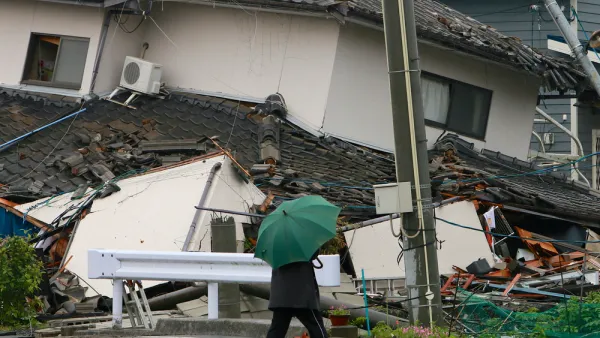
A 7.5 magnitude earthquake struck the Indonesian island of Sulawesi on Sept. 25, followed by a massive tsunami. Soil liquefaction caused by the tremor resulted in 1,700 homes being "swallowed" as the soil shifted. Deaths exceeded 1,400 on Oct. 3.
Prepared for Disaster, But not to Respond
Japan is typically associated with strong disaster preparedness plans, but the devastation following the March tsunami highlights some of the nation's shortcomings in adapting and reacting, according to this piece from Citiwire.
The Transcendent Urbanism of Japan
Architect Vishaan Chakrabarti writes that Japan's urbanism should serve as a model to the rest of the world for its density and the "urbane society" it creates.

Planetizen Federal Action Tracker
A weekly monitor of how Trump’s orders and actions are impacting planners and planning in America.

Amtrak, CN end decades-long dispute with eight-year agreement
The new operating agreement establishes an updated framework for the companies to work together, including processes to resolve disputes.

Judges permit Denver to divert 77,000 acre feet from the Colorado River for reservoir expansion
Overuse and climate change have caused the Colorado River’s water levels to plummet.

Philadelphia to invest $2 billion into upgrading city airports as PHL places last in customer satisfaction
Modernizations to Philadelphia's airports will include baggage system upgrades and a new automated parking garage guidance system.

The LA housing policies making developers turn away from the city
Despite LA’s housing shortage, developers say the city’s "mansion-tax" and pandemic-era policies make it an unappealing place to build housing.

New density bill would require 7 California cities to establish regional transit hubs
The bill would also require major cities in California to permit high-rise residential buildings.

FREE Course: Walkable City 1: Why Walkability?
After describing his path towards focusing on walkability as the essence of good planning, Jeff Speck marches through his five principal reasons for making more walkable places.
Reinventing Malls: Planning Alchemy—Turning Gray Fields Into Gold
The course focuses on the opportunities and imperatives that shape reinvention of mall sites.

City of Wisconsin Rapids
Harvard University Graduate School of Design
KFH Group Inc.
The Architects Foundation
University of Cincinnati Online
The Pocatello Development Authority
The Urban Renewal Agency of the City of Pocatello