Developers in Mumbai will be allowed to build street furniture and sell advertising space on it as part of their projects, in accordance with a new law in the city.


Locals are hopeful that the law will bring about new public amenities and a cut from advertising revenues into the city's coffers. But some worry the program could be abused.
"More than a year after announcing their plans to beautify the city, just a couple of weeks ago, Subodh Kumar, Municipal Commissioner of Mumbai, sanctioned a scheme to allow private builders and developers to install street furniture on specific streets in exchange for advertising rights on that furniture as 10 per cent of the revenues to go to the Brihanmumbai Municipal Corporation (BMC).
Kumar went on record to state that the project would now be implemented across the city, except in areas delineated by the Mumbai Heritage Conservation Committee (MHCC)."
Read the full story: Mumbai to get a facelift with street furniture
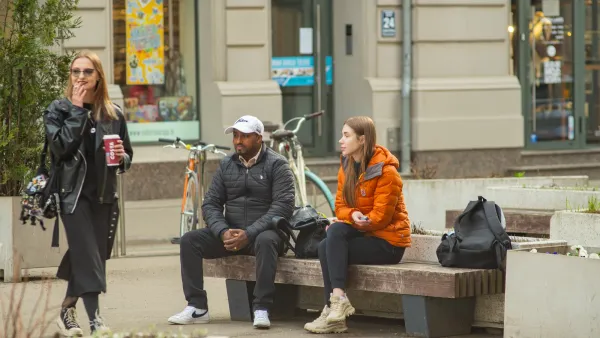
Where have all the public benches gone?
Public seating can be an indicator of broader trends in who gets to use public space — and how.

India’s Women-only ‘Pink Parks:’ Safe Refuge or Segregated Enclaves?
Women-only public spaces can provide safety and community, but critics argue they fail to address deeper structural problems.

Creative Ways to Activate Roofless Buildings and Vacant Lots
Pocket parks aren’t the only way to repurpose underused urban spaces.

Planetizen Federal Action Tracker
A weekly monitor of how Trump’s orders and actions are impacting planners and planning in America.

California plans to bury El Niño’s downpour
If the state plays its cards right, it may be able to store a billion acre-feet of El Niño’s water in aquifers.

Desperate measures: Advocates weigh draining Lake Powell to fill Colorado River
Draining the reservoir could reduce evaporation losses by a couple hundred thousand acre-feet.

Mamdani’s pied-à-terre tax survives legal challenge
A panel of judges found that the plaintiffs failed to demonstrate injury as a result of New York City's implementation of the tax.

Eastern Nebraska is running out of electricity
Data centers and electrification are straining eastern Nebraska’s grid, throttling economic development.

Seattle passes record-breaking transit services expansion
Proposition 1 will double the city’s transit tax to add 95,000 more bus trips and preserve 180,000 bus trips annually.

FREE Course: Walkable City 1: Why Walkability?
After describing his path towards focusing on walkability as the essence of good planning, Jeff Speck marches through his five principal reasons for making more walkable places.
Reinventing Malls: Planning Alchemy—Turning Gray Fields Into Gold
The course focuses on the opportunities and imperatives that shape reinvention of mall sites.

City of Rosemead
Rutgers University, Edward J. Bloustein School of Planning and Public Policy
One Hundred Miles
University of Michigan School for Environment and Sustainability (SEAS)
Hunter College, City University of New York (CUNY)
The Architects Foundation
City of Cambridge
Montrose County
The Pocatello Development Authority