Architecture critic Christopher Hume writes an homage to urban planning icon Jane Jacobs, highlighting the resiliency of her positions on density and diversity.


Jacobs' influence on her adopted hometown of Toronto live on, as do many of the issues she so vehemently advocated against. Christopher Hume of the Toronto Star says her principles of diversity and density are applied when convenient, shunned when not. Her impact remains, but so does the anti-urban bias:
"Death and Life gave shape and form to the idea of the city. It has helped generations understand how the ordinary comings and goings are signs of a healthy city."
"Yet outside the core we continue to practise what the late Metro boss Fred Gardiner once called 'multiplication by subdivision.' For the many who view the city as a Dickensian hell - dirty, dangerous and diseased - fleeing to the 'burbs is as inevitable as marriage and parenthood."
Read the full story: Death and Life still lives, even in Ford Nation

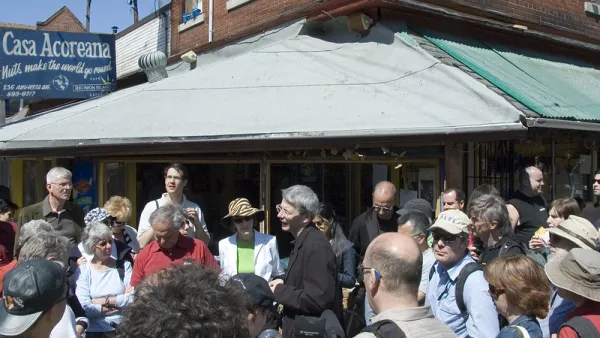
Jane's Walks Adjusts to Social Distancing
The Jane's Walks festival take place the first weekend of May in cities all over the world. In 2020, social distancing will require a different format for the citizen-led group walk event.

The 'Jane's Walk' Tradition Continues
In honor of the pioneering urbanist, who would have been 101 years old this week, citizens are organizing "Jane's Walks" in cities across the globe.

Planetizen Federal Action Tracker
A weekly monitor of how Trump’s orders and actions are impacting planners and planning in America.

HUD modernizes 50-year-old manufactured housing framework
The Next Generation Manufactured Housing Action Plan establishes new energy-efficiency standards for manufactured homes, and new guidelines for anchoring them.

Data reveals that NYC’s bet on congestion pricing has paid off
After almost two years of the program, reports show positive impacts on traffic and air quality and no disruptions to parking.

How Chicago, New York and Seattle are funding transit projects amid tough times
Notes from the American Public Transportation Association's TransForm conference in Chicago.

Transport for London tackles hate crime spike with free bystander training
Recorded hate crime offences on the London's transport network have increased by 36 per cent.

Denver is solving homelessness. Why aren't the rest of us?
Since 2023, Denver's street homeless population has decreased by 64%, proving that effective tools exist to support those in need of housing.

FREE Course: Walkable City 1: Why Walkability?
After describing his path towards focusing on walkability as the essence of good planning, Jeff Speck marches through his five principal reasons for making more walkable places.
Reinventing Malls: Planning Alchemy—Turning Gray Fields Into Gold
The course focuses on the opportunities and imperatives that shape reinvention of mall sites.

One Hundred Miles
County of Mendocino
planning NEXT
The Architects Foundation
University of Cincinnati Online
Montrose County
Northern Illinois Transit Authority (NITA)
The Pocatello Development Authority