The TDR, or transfer of development rights, could be a way for Canadian cities to reduce the expansion of its sprawling cities, according to this piece.


Written by Sumeet Gulati, an Associate Professor at the University of British Columbia, this article argues that Canadian cities can learn from the successful use of TDRs in the U.S.
"There is one policy instrument that raises the cost of suburban development without hurting local landowners: Transferable Development Rights (TDR's). This instrument has been successfully tried in the U.S. and our governments could improve on their experience. TDR's allow the sale of development rights from a protected area to areas suitable for densification.
In 1998, Chesterfield, N.J., located about 55 kilometres from Philadelphia, adopted a TDR program to protect its rural character. The aim was to divert new development into a dense new site away from prime farmland and the historic city centre. The township required builders to buy TDR's in order to build in a planned mixed-use site close to the New Jersey Turnpike. Owners could sell 1 development right per 10 acres of farmland. As of April 2007, approximately 91 per cent of the units proposed for the mixed-used development were contracted, and 3,200 acres of farmland had been preserved. The price for a one TDR in the last auction, held in 2004, was $50,000."
Read the full story: Reducing sprawl doesn’t require a heavy hand

The Forgotten Treasure in Western Land
Will the arid West’s farms and settlements thrive for another century? Better conservation policy should take a longer view.
The Race for Manhattan's Rarified Air
Buoyed by a recovering real estate market, and a race to build the tallest and most exclusive residential towers in the city, Manhattan is experiencing a surge in air-rights deals. Robin Finn explores the nuances of this complex market.
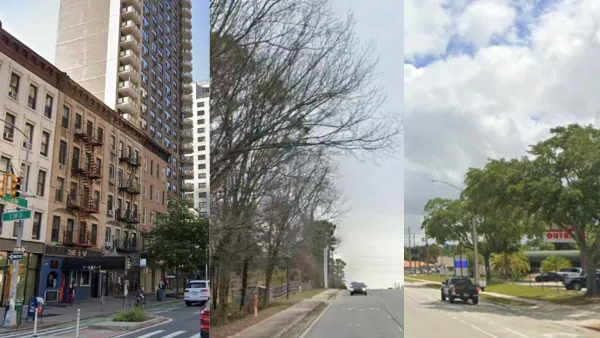
A Transect of sprawl
A development pattern this lifestyle-defining deserves its whole own classification system.

Amtrak, CN end decades-long dispute with eight-year agreement
The new operating agreement establishes an updated framework for the companies to work together, including processes to resolve disputes.

Northwest rail fans eager for Sept. 30 debut of Amtrak’s Airo fleet
Get ready for that new train smell and more seats. But they won’t go faster or run more frequently on the Cascades route in Washington and Oregon.

Judges permit Denver to divert 77,000 acre feet from the Colorado River for reservoir expansion
Overuse and climate change have caused the Colorado River’s water levels to plummet.

NYC to turn city-owned property into thousands of homes
The city has scheduled a public hearing regarding the development for October.

Buses travel at 5mph along this route in NYC. The Bronx's first-ever busway looks to change that
Prior to the busway, buses on the Bx36 route traveled as slowly as 5 miles per hour.

Pittsburg launches 'EZ permits,' aims for one-day turnaround for low-risk permits
The pilot ‘fast lane’ for permits is part of a bundle of modernization efforts for Pittsburg’s permitting process.

FREE Course: Walkable City 1: Why Walkability?
After describing his path towards focusing on walkability as the essence of good planning, Jeff Speck marches through his five principal reasons for making more walkable places.
Reinventing Malls: Planning Alchemy—Turning Gray Fields Into Gold
The course focuses on the opportunities and imperatives that shape reinvention of mall sites.

City of Thousand Oaks
City of Wisconsin Rapids
Harvard University Graduate School of Design
The Architects Foundation
University of Cincinnati Online
The Pocatello Development Authority
The Urban Renewal Agency of the City of Pocatello