A new report from NYU's Furman Center for Real Estate and Urban Policy reveals that the parking minimums required for new developments are a significant part of why housing in New York is so expensive.


Authors Simon McDonnell, Josiah Madar and Vicki Been show in the report that developers never add more parking than is required, which they say shows that parking minimums are artificially inflating the construction of parking spaces.
Noah Kazis reports:
"Looking at every large, market-rate and entirely residential building completed in Queens between 2000 and 2008, the authors compared how much parking was required by zoning to how much was actually constructed. Of the 38 buildings that met those criteria, 18 of them had exactly the amount of parking required by the minimum. Another four actually had less than required, perhaps because they received a variance. Only five buildings built more than four more spaces than required. 'That would suggest the minimum is quite binding,' McDonnell concluded."
Thanks to Noah Kazis
Read the full story: Parking Minimums Make NYC Housing More Expensive, NYU Report Finds

Developer: I've Walked Away From Projects Because of Parking Minimums
Why is it so hard to build in New York City? Why are rents so expensive? It's partly because parking requirement are so onerous that developers are doing everything they can to avoid them, writes Noah Kazis.

Study: Eliminating Parking Requirements Would Boost Denver Housing by 12.5%
Denver and other Colorado cities have recently reduced or eliminate parking requirements, paving the way to more affordable housing development.
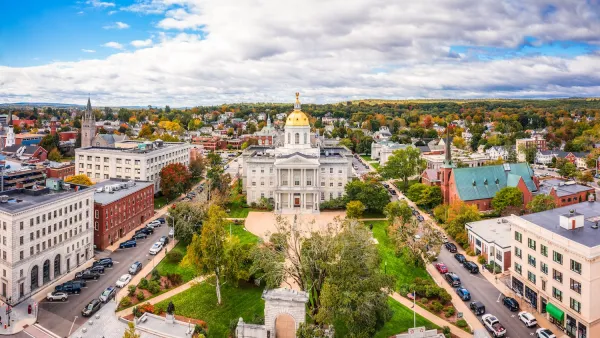
New Hampshire House Passes Parking Reform Bill
The revised bill, which caps parking requirements at one spot per residential unit and eliminates exemptions, will go back to the Senate for a new vote.

Planetizen Federal Action Tracker
A weekly monitor of how Trump’s orders and actions are impacting planners and planning in America.

California plans to bury El Niño’s downpour
If the state plays its cards right, it may be able to store a billion acre-feet of El Niño’s water in aquifers.

Chicago breaks ground on $3 billion megadevelopment
The new neighborhood, titled Foundry Park, will one day host 3,700 residences.

Satanic place names
From streams and lakes to valleys and canyons, I mapped more than 1,000 places named after the Devil.

California High-Speed Rail Authority CEO resigns after $600,000 scandal
Under Ian Choudri, the authority used taxpayer dollars to fund first class flights and trips to nightclubs.

Want to study the Missouri River? Soon, you may need unanimous approval from 10 states
Legislation would require 10 governors’ permission to study or build projects moving water outside the basin.

FREE Course: Walkable City 1: Why Walkability?
After describing his path towards focusing on walkability as the essence of good planning, Jeff Speck marches through his five principal reasons for making more walkable places.
Reinventing Malls: Planning Alchemy—Turning Gray Fields Into Gold
The course focuses on the opportunities and imperatives that shape reinvention of mall sites.

City of Rosemead
Rutgers University, Edward J. Bloustein School of Planning and Public Policy
One Hundred Miles
Hunter College, City University of New York (CUNY)
The Architects Foundation
University of Cincinnati Online
City of Cambridge
Montrose County
The Pocatello Development Authority