Urban explorer dsankt offers an in-depth look inside abandoned sections of the Metro system of Paris.


This post explores the system, and presents a unique look inside parts of the system few have seen in decades.
"Before developing a deeper appreciation of the system we were drawn initially to the abandoned stations. Some of these seem totally abandoned and haven't been reappropriated for other uses, some have become RATP storage and others, even more rare, were never even open to the public. With time we would conquer them all.
The stations Arsenal and Champ de Mars are the easiest to visit as they can be reached from the topside so they're as good a place to begin as any. While situated at opposite sides of the city these two stations share a similar story. They were closed on the same day, 2nd September 1939, when the metro employees were recruited to join the war effort. After the conclusion of the war they were never reopened for general service as they're simply so close to other stations. The paris metro is one of the most dense in the world with an average distance between stations of ~500m."
Thanks to BLDGBLOG
Read the full story: Demolition of the Paris Metro

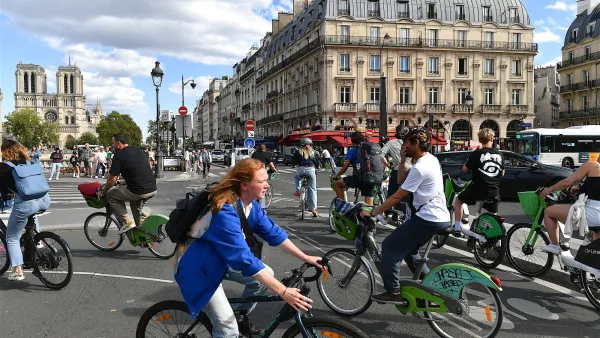
Biking in Paris grew by 240% in 5 years
The city saw a significant rise in bike use thanks to data-driven policy changes.
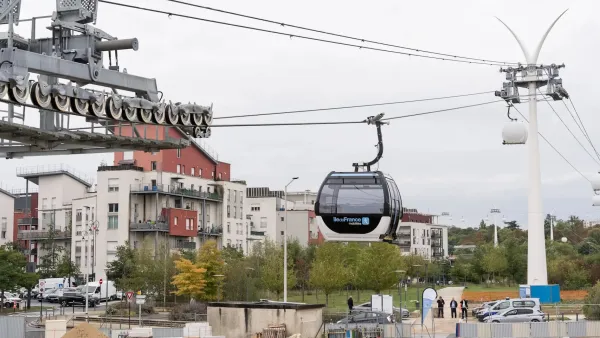
Paris Opens Europe’s Longest Aerial Gondola Line
The new cable car line, France’s seventh, is expected to carry roughly 11,000 passengers per day.

France Tightens Restrictions on Short-Term Rentals
The vacation rental market is shouldering part of the blame for rising housing costs, particularly in popular tourist destinations.

Planetizen Federal Action Tracker
A weekly monitor of how Trump’s orders and actions are impacting planners and planning in America.

Amtrak, CN end decades-long dispute with eight-year agreement
The new operating agreement establishes an updated framework for the companies to work together, including processes to resolve disputes.

Judges permit Denver to divert 77,000 acre feet from the Colorado River for reservoir expansion
Overuse and climate change have caused the Colorado River’s water levels to plummet.

Idaho may see an 18% drop in federal surface transit funding — the largest estimated cut in the US
Transit systems in rural communities are much more reliant on federal funding to provide their services.

How ‘post-disaster gentrification’ alters neighborhoods after natural calamities
After hurricanes, fires or other calamities, the original residents of a community are often replaced by younger, wealthier residents.

Maryland local governments examine if they should have more power to raise property taxes
Maryland’s housing market is out of reach for the majority of moderate-income residents.

FREE Course: Walkable City 1: Why Walkability?
After describing his path towards focusing on walkability as the essence of good planning, Jeff Speck marches through his five principal reasons for making more walkable places.
Reinventing Malls: Planning Alchemy—Turning Gray Fields Into Gold
The course focuses on the opportunities and imperatives that shape reinvention of mall sites.

Harvard University Graduate School of Design
KFH Group Inc.
Greater Baltimore Committee
The Architects Foundation
University of Cincinnati Online
The Pocatello Development Authority
The Urban Renewal Agency of the City of Pocatello