The new cable car line, France’s seventh, is expected to carry roughly 11,000 passengers per day.


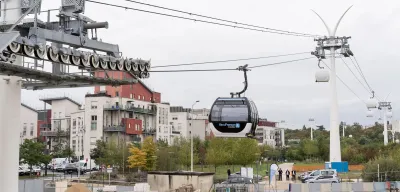
Paris unveiled Europe’s longest aerial cable car line, a system of 105 gondolas that is expected to carry roughly 11,000 passengers per day. “At 4.5 kilometres long, the route links Métro Line 8 in Créteil to Villa Nova in Villeneuve-Saint-Georges, and passes through Limeil-Brevannes and Valenton on the way.” For reference, the world’s longest cable car line, located in Bolivia, is over 32 kilometers long. The new line, Câble C1, is France’s seventh urban cable car. Others operate in Toulouse, Brest, and Saint-Denis de La Réunion.
As Sophie-May Williams reports in Metro, the cable car’s total journey takes about 18 minutes, compared to roughly 40 minutes by bus or car. “Grégoire de Lasteyrie, Vice President for Transport of the Île-de-France regional council, said the €138 million project was a cheaper alternative to building subways to connect the isolated neighbourhoods.”
Paul Herriotts, Professor of Transport Design at Coventry University, says a similar system could work in London, if designed thoughtfully. There, one gondola experiment built for the 2012 Olympics proved to only serve tourists, flopping as a real mode of transport for local residents.
FULL STORY: Europe’s longest urban cable car is unveiled over dazzling capital city

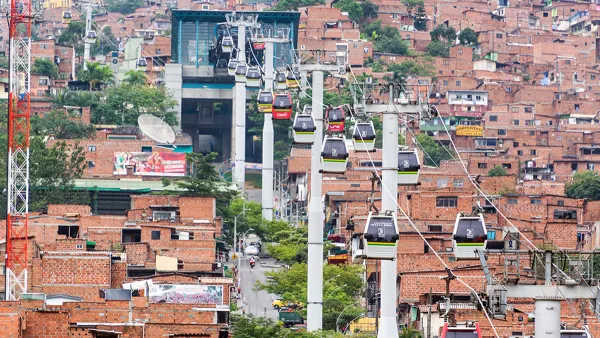
Paris Approves First Aerial Gondola
An aerial tramway project in the French capital cleared feasibility studies and could open in 2025.
8 Lessons from the Paris Metro
Transportation planner Dan Malouff shares eight insights into what makes the Paris Metro one of the world's great subways.

Biking in Paris grew by 240% in 5 years
The city saw a significant rise in bike use thanks to data-driven policy changes.

Planetizen Federal Action Tracker
A weekly monitor of how Trump’s orders and actions are impacting planners and planning in America.

The state-sanctioned urbicide of Austin
People don’t kill cities. Freeways do.

US to reduce Colorado River water deliveries to Mexico
A new Colorado Treaty amendment reduces Mexico’s Colorado River water allocation by 250,000 acre feet.

5 New England states march closer to 800 megawatt wind energy project
Securing federal approval for the project may be complicated under the Trump administration, which has historically been hostile towards domestic wind power.

Baltimore to break ground on $50 million Transit Priority Project
The project will bring faster bus trips, safer streets and better bike connections to Baltimore.

Airbnb launches $250 million 'last-dollar financing' housing accelerator, makes first investment in Austin
The company will put $6.4 million towards affordable housing development in Texas’ capital.

FREE Course: Walkable City 1: Why Walkability?
After describing his path towards focusing on walkability as the essence of good planning, Jeff Speck marches through his five principal reasons for making more walkable places.
Reinventing Malls: Planning Alchemy—Turning Gray Fields Into Gold
The course focuses on the opportunities and imperatives that shape reinvention of mall sites.

Eagle County Government
Harvard University Graduate School of Design
Nashville Planning Department
The Architects Foundation
University of Cincinnati Online
The Pocatello Development Authority
The Urban Renewal Agency of the City of Pocatello
Journal of the American Planning Association