Since reunification in 1989, many East German cities have been devastated by failing economies and population loss. The Germans, therefore, have a leg up on management strategies for failing cities. Doreen Ritzau takes a tour.


Ritzau writes:
"A first impression offers a portrait of urban resilience made possible by an emerging toolkit of tactics-new kinds of ecological infrastructure, small-scale urban interventions, targeted demolition, and citizen-activism-coupled with economic development strategies like tourism, education, and high-tech incubators. In Magdeburg, for instance, a revitalized riverfront is the core of a new urban identity, with an old port reinvented as a science center and other brownfield sites returned to nature. The city of Köthen tapped its heritage as the birthplace of homeopathic medicine, building a new European library for homeopathy and exploring how alternative medical principles might even heal the urban landscape. "
Some East German cities have used the sort of landscaping/urban greening techniques being discussed for American cities like Detroit and Cleveland. Ritzau looks at how well these strategies are working.
Read the full story: IBA 2010: The Future Shrinks


Learning loss and urban schools, part 2
Did test scores in progressive cities drop more post-COVID than test scores in moderate ones?

Detroit to transform waterfront with $2.2 billion investment
Developers will convert about 18 acres of unused parking lot space into civic spaces.
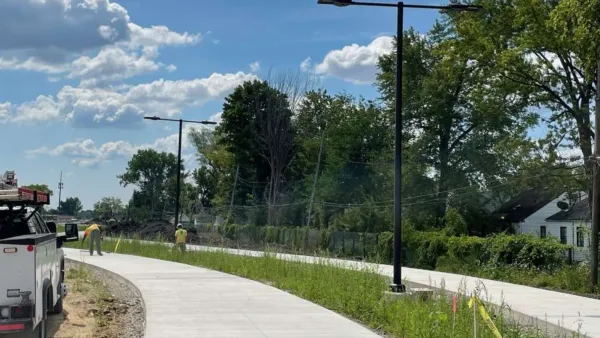
Detroit greenway brings revival — and fears of displacement
The planned Joe Louis Greenway is already bringing change to the neighborhoods near it.

Planetizen Federal Action Tracker
A weekly monitor of how Trump’s orders and actions are impacting planners and planning in America.

California plans to bury El Niño’s downpour
If the state plays its cards right, it may be able to store a billion acre-feet of El Niño’s water in aquifers.

Chicago breaks ground on $3 billion megadevelopment
The new neighborhood, titled Foundry Park, will one day host 3,700 residences.

California High-Speed Rail Authority CEO resigns after $600,000 scandal
Under Ian Choudri, the authority used taxpayer dollars to fund first class flights and trips to nightclubs.

Want to study the Missouri River? Soon, you may need unanimous approval from 10 states
Legislation would require 10 governors’ permission to study or build projects moving water outside the basin.

Desperate measures: Advocates weigh draining Lake Powell to fill Colorado River
Draining the reservoir could reduce evaporation losses by a couple hundred thousand acre-feet.

FREE Course: Walkable City 1: Why Walkability?
After describing his path towards focusing on walkability as the essence of good planning, Jeff Speck marches through his five principal reasons for making more walkable places.
Reinventing Malls: Planning Alchemy—Turning Gray Fields Into Gold
The course focuses on the opportunities and imperatives that shape reinvention of mall sites.

City of Rosemead
Rutgers University, Edward J. Bloustein School of Planning and Public Policy
One Hundred Miles
Hunter College, City University of New York (CUNY)
The Architects Foundation
University of Cincinnati Online
City of Cambridge
Montrose County
The Pocatello Development Authority