As the debate over new bike lanes pits New Yorkers against each other, people should refocus on the economic benefits the lanes can provide, argues Richard Florida.


"[L]et's get past the culture wars and face some economic facts.
Like it or not, New York has become a haven for creative class professionals - who also happen to do freelance writing, filmmaking, software developing and a whole host of other important jobs. It needs them to maintain its competitive edge in a host of fields from finance to publishing and digital media. They don't give up their lifestyle preferences as they age. They don't stop bicycling or running, for instance, just because they have children. When they put their kids in child seats or jogging strollers, traffic-free bike paths become especially important to them."
Building bike lanes, Florida argues, is an easy way to lure the creative types that help fuel the modern economy in cities.
Read the full story: Bike lane critics are wrong: Why New York needs to make way for cyclists
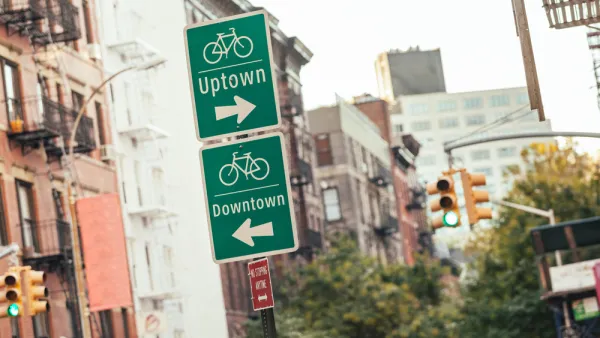
Op-Ed: NYC Making Progress on Bike Network Access, Should Do More
2019 was the first year in which New York City's Department of Transportation kept affected bike lanes open during the UN's General Assembly. That should be a sign of things to come, advocates argue.
NYC to vote on supporting outdoor dining, streamlining bus and bike lane creation
The city has five proposed amendments to its municipal constitution on the ballot this November.
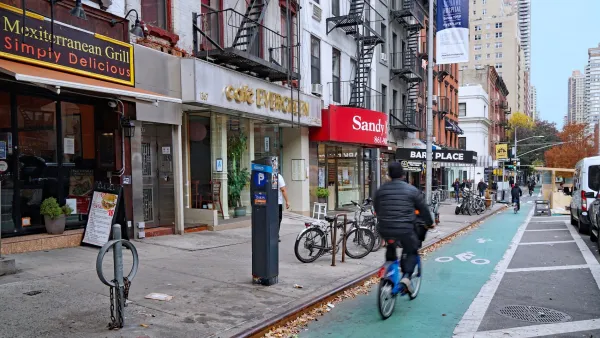
Study: Protected bike lanes increase Citi Bike rides by nearly 400 rides a month
An analysis of millions of NYC bike share rides reveals that only protected bike lanes have a 'statistically significant' increase in ridership.

Planetizen Federal Action Tracker
A weekly monitor of how Trump’s orders and actions are impacting planners and planning in America.

Eastern Nebraska is running out of electricity
Data centers and electrification are straining eastern Nebraska’s grid, throttling economic development.

Washington state to charge fee to drivers with fuel-efficient cars
Revenue from the fee will go towards supporting the state’s highways.

Instead of building new housing, LA developers are turning mansions into mega-mansions
In the richest areas, the number of houses valued at $30 million with demolition permits has skyrocketed since 2018.

Illinois considers spending $1 billion in taxpayer money on data center
A quantum computing campus and data center are currently under construction in Chicago.

As development costs rise, Boston moves to lessen affordable housing requirements
The Boston Zoning Commission and the City Council still need to approve Boston Mayor Michelle Wu’s proposed changes

FREE Course: Walkable City 1: Why Walkability?
After describing his path towards focusing on walkability as the essence of good planning, Jeff Speck marches through his five principal reasons for making more walkable places.
Reinventing Malls: Planning Alchemy—Turning Gray Fields Into Gold
The course focuses on the opportunities and imperatives that shape reinvention of mall sites.

City of Charlotte
City of Rosemead
Rutgers University, Edward J. Bloustein School of Planning and Public Policy
University of Michigan School for Environment and Sustainability (SEAS)
Hunter College, City University of New York (CUNY)
The Architects Foundation
University District Partnership
City of Cambridge
The Pocatello Development Authority