Only 2% of bike riders in Lima are women. Jonna McKone looks at what hinders women from hopping on bikes and the further implications.


McKone looks at the World Bank's Transport Rehabilitation Project (TRP) to improve road maintenance and mobility of the poor, specifically women, by focusing on biking:
"Funded until 2000, the project fell down on a number of fronts, however, the city has taken on a renewed focus on mobility with its work to develop Metropolitano, a bus rapid transit (BRT) system in Lima, and biking activism is gaining ground, especially with a new law in Peru that gives priority to biking legislation.
In the mid 1990s, The World Bank loaned $200 million to Peru, "designed to provide credit to low-income formal and informal sector workers to buy bikes, so they could access jobs." Only those who could prove the bikes were used to access places of work were provided with the loans."
Thanks to Garrett Bradford
Read the full story: Female Bikers as Indicator for Street Safety in Latin America
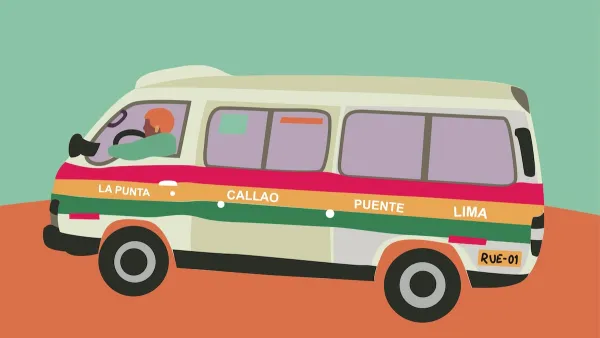
Urban Planning in Lima, Peru
For some people, ‘urban planning’ and ‘Lima’ do not go together. In fact, the Peruvian capital effectively highlights various facets of the urban planning world.
New Transit Systems of 2010
Garrett Bradford of TheCityFix reviews some of the most innovative and sustainable transit systems from around the globe that made their debut over the last twelve months.
For Women Only: Safety by Segregation
Women's safety on public transit is increasingly in focus worldwide. Many systems have turned to designating separate areas for women, but what happens after they get off?

Planetizen Federal Action Tracker
A weekly monitor of how Trump’s orders and actions are impacting planners and planning in America.

Eastern Nebraska is running out of electricity
Data centers and electrification are straining eastern Nebraska’s grid, throttling economic development.

Study reveals best places in the U.S. for cycling, walking
New research from Streetlight Data examines bicycle and pedestrian miles per capita in the 100 largest U.S. cities by population.

Federal government nominates new FTA administrator
Mark Aesch is currently the founder and CEO of a transportation management consulting firm.

Developers reveal $10 billion stadium plan as ‘Hail Mary’ to keep Bears in Chicago
The plan would also boast a public park, high- and mid-rise buildings and a youth sports complex.

As Texas embraces carbon storage, a Black community questions the risks
Texas now issues permits for companies to store carbon dioxide underground. East Texas residents fear safety risks, and skeptics doubt the climate benefits.

FREE Course: Walkable City 1: Why Walkability?
After describing his path towards focusing on walkability as the essence of good planning, Jeff Speck marches through his five principal reasons for making more walkable places.
Reinventing Malls: Planning Alchemy—Turning Gray Fields Into Gold
The course focuses on the opportunities and imperatives that shape reinvention of mall sites.

City of Charlotte
City of Rosemead
Rutgers University, Edward J. Bloustein School of Planning and Public Policy
University of Michigan School for Environment and Sustainability (SEAS)
Hunter College, City University of New York (CUNY)
The Architects Foundation
City of Cambridge
The Pocatello Development Authority
The Urban Renewal Agency of the City of Pocatello