Officials in Cambodia are hoping to capitalize on tourists' interest in the killing fields of the Khmer Rouge regime with a proposed theme park.


But his is not the typical theme park. The idea is to recreate and restore a number of historic buildings in the village of Anlong Veng, the last place of resistance in the late 1970s as the Khmer Rouge fell.
"The Cambodian government plans to develop this sun-baked, mine-riddled frontier town into a theme park devoted to the Khmer Rouge, the brutal regime that murdered perhaps 15 percent of Cambodia's population when it ruled from 1975 to 1979. The planned park is of a piece with Cambodia's larger effort to capitalize on the atrocities of its past-and to tap into a booming global industry in travel to macabre destinations, known as thanatourism.
Cambodia depends on tourism for about a fifth of its GDP. Its premier attraction is Angkor Wat, the magnificent complex of ancient Buddhist and Hindu buildings, which draws 2 million visitors annually, by some estimates. But hundreds of thousands of tourists also visit two sites in Phnom Penh with a more grotesque appeal: S21, a Khmer torture center that later became a museum; and the killing fields at Choeung Ek, where some 9,000 bodies were buried en masse and where more than 5,000 human skulls are displayed in a glass-and-concrete stupa."
Read the full story: Dark Tourism

Tourist-Centric Venice Loses Population
As floods increase and the tourist-focus of the city pervades, Venice, Italy is losing much of its charm -- and its native population.
Cambodian Cool
The Cambodian city of Siem Reap is a hotbed of tourist activity -- and of tacky hotels. Many say this sprawl of hotels is a major problem in the city, but new designs are making the city a cooler place to visit and live.
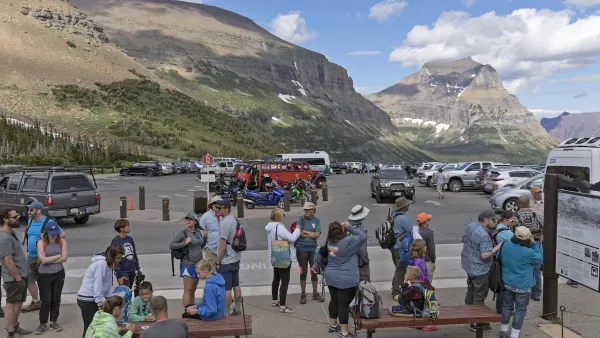
Glacier National Park drops reservation requirement, plans to double down on shuttle network
Since 2021, visitors with cars have had to make a reservation to access the park.

Planetizen Federal Action Tracker
A weekly monitor of how Trump’s orders and actions are impacting planners and planning in America.

Amtrak, CN end decades-long dispute with eight-year agreement
The new operating agreement establishes an updated framework for the companies to work together, including processes to resolve disputes.

Judges permit Denver to divert 77,000 acre feet from the Colorado River for reservoir expansion
Overuse and climate change have caused the Colorado River’s water levels to plummet.

NYC DOT wants faster, more permanent street upgrades
The city is examining ways to build more concrete infrastructure without getting entangled in 'decades-long' projects.

'Something we’ve never seen before:' rising utility rates could strain city finances nationwide
Data centers, climate change and other factors have caused utility rates in the United States to increase by 38% since 2020.

Trump to overrule local leaders, lease millions of acres of America’s Pacific Island territories’ seafloors to mining companies
International law says that the Indigenous people of America’s territories have a right to prior and informed consent regarding projects that impact their countries.

FREE Course: Walkable City 1: Why Walkability?
After describing his path towards focusing on walkability as the essence of good planning, Jeff Speck marches through his five principal reasons for making more walkable places.
Reinventing Malls: Planning Alchemy—Turning Gray Fields Into Gold
The course focuses on the opportunities and imperatives that shape reinvention of mall sites.

Harvard University Graduate School of Design
KFH Group Inc.
Greater Baltimore Committee
The Architects Foundation
University of Cincinnati Online
The Pocatello Development Authority
The Urban Renewal Agency of the City of Pocatello