With the debut of the latest map of the Moscow Metro, TheCityFix's Jonna McKone takes a look at mass transit maps from across the globe and chats with mapmaker Cameron Booth.


According to McKone, "Moscow's new map took four years to develop, according to the design firm behind it, Art. Lebedev Studio. Its design is meant to be scalable to various sizes and complexity. A lot attention was paid to graphically representing the intersections of various transit lines.
Graphic designer Cameron Booth, who redesigned Washington, D.C.'s Metro map as a personal project (it's not publicly in use), answered a few of our questions about mapping. First off, Booth says transit maps are not really maps at all; they are 'diagrams that show connections between points and not the accurate geography of an area.' New York City's subway map is the major exception to this rule.
Thanks to Garrett Bradford
Read the full story: Moscow Metro Map and Usability of Public Transportation Maps

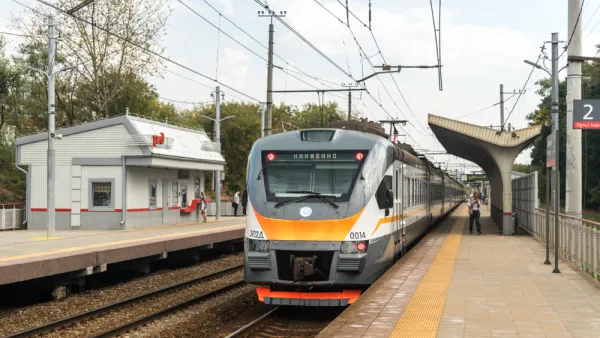
A New Suburban Rail System for Moscow
Two of a planned five new suburban rail routes, modeled on examples in Paris and Berlin, opened last week in Russia.
Wayfinding Symbols Across the World
Metro stations, train stations and streetcar systems have distinct ways of showing how to get from one area to another. TheCityFix's Jonna McKone looks at mass transit systems from Mexico City to Paris and the visual representations used in each one.
Friday Funny: Moscow Dogs Commute via Subway
Dogs in Moscow have learned to ride the subway to and from "work".

Amtrak, CN end decades-long dispute with eight-year agreement
The new operating agreement establishes an updated framework for the companies to work together, including processes to resolve disputes.

Northwest rail fans eager for Sept. 30 debut of Amtrak’s Airo fleet
Get ready for that new train smell and more seats. But they won’t go faster or run more frequently on the Cascades route in Washington and Oregon.

Judges permit Denver to divert 77,000 acre feet from the Colorado River for reservoir expansion
Overuse and climate change have caused the Colorado River’s water levels to plummet.

NYC to turn city-owned property into thousands of homes
The city has scheduled a public hearing regarding the development for October.

Buses travel at 5mph along this route in NYC. The Bronx's first-ever busway looks to change that
Prior to the busway, buses on the Bx36 route traveled as slowly as 5 miles per hour.

Pittsburg launches 'EZ permits,' aims for one-day turnaround for low-risk permits
The pilot ‘fast lane’ for permits is part of a bundle of modernization efforts for Pittsburg’s permitting process.

FREE Course: Walkable City 1: Why Walkability?
After describing his path towards focusing on walkability as the essence of good planning, Jeff Speck marches through his five principal reasons for making more walkable places.
Reinventing Malls: Planning Alchemy—Turning Gray Fields Into Gold
The course focuses on the opportunities and imperatives that shape reinvention of mall sites.

City of Thousand Oaks
City of Wisconsin Rapids
Harvard University Graduate School of Design
The Architects Foundation
University of Cincinnati Online
The Pocatello Development Authority
The Urban Renewal Agency of the City of Pocatello