A new report suggests that making policies in Canada to avoid urban sprawl development will reduce pollution and boost the economy.


By shifting away from sprawling development patterns, Canadian metropolitan areas could reduce their greenhouse gas emissions and save money in the long-run.
"The study, published by a coalition of industry and government stakeholders, warns that a business-as-usual scenario could wind up costing billions of dollars and lock the country into a path that ensures higher energy consumption and pollution.
'Unlike many other GHG (greenhouse gas) emissions reduction strategies . . . many of these policies and actions can be enacted effectively and independently by local (municipal) governments, provided that they are empowered to do so,' said a summary of the report, obtained by Postmedia News. 'This allows our communities to make a substantial contribution to GHG emission and energy use reductions, even in the absence of significant federal action.'"
Read the full story: Avoiding urban sprawl could reduce pollution, boost economy: report

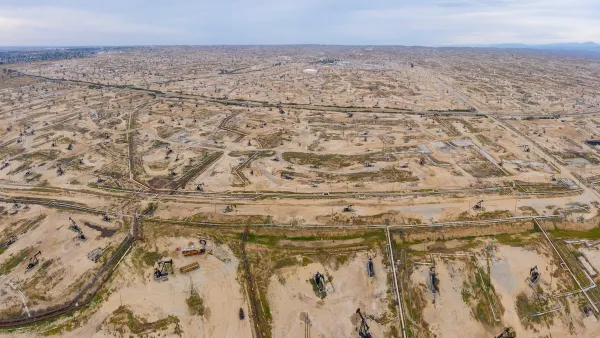
California County Approves Underground Carbon Storage Project
Kern County supervisors voted to support a carbon storage project that will inject climate-warming gases into a former oil and gas field.

Providence Could Ban New Gas Stations
The city could prohibit the construction of new fueling stations within city limits to discourage driving and pave the way for more renewable transportation infrastructure.

EVs Reduce Greenhouse Gas Emissions, but They're Not Pollution-Free
To reduce harmful particulate matter emissions, we need fewer cars on the road—electric or otherwise, according to the findings of a recent report.

Planetizen Federal Action Tracker
A weekly monitor of how Trump’s orders and actions are impacting planners and planning in America.

California plans to bury El Niño’s downpour
If the state plays its cards right, it may be able to store a billion acre-feet of El Niño’s water in aquifers.

Chicago breaks ground on $3 billion megadevelopment
The new neighborhood, titled Foundry Park, will one day host 3,700 residences.

California High-Speed Rail Authority CEO resigns after $600,000 scandal
Under Ian Choudri, the authority used taxpayer dollars to fund first class flights and trips to nightclubs.

Want to study the Missouri River? Soon, you may need unanimous approval from 10 states
Legislation would require 10 governors’ permission to study or build projects moving water outside the basin.

Desperate measures: Advocates weigh draining Lake Powell to fill Colorado River
Draining the reservoir could reduce evaporation losses by a couple hundred thousand acre-feet.

FREE Course: Walkable City 1: Why Walkability?
After describing his path towards focusing on walkability as the essence of good planning, Jeff Speck marches through his five principal reasons for making more walkable places.
Reinventing Malls: Planning Alchemy—Turning Gray Fields Into Gold
The course focuses on the opportunities and imperatives that shape reinvention of mall sites.

City of Rosemead
Rutgers University, Edward J. Bloustein School of Planning and Public Policy
One Hundred Miles
Hunter College, City University of New York (CUNY)
The Architects Foundation
University of Cincinnati Online
City of Cambridge
Montrose County
The Pocatello Development Authority