Writing in The New York Times, Geoff Manaugh looks at Christoph Gielen's aerial photography of urban development and sprawl.


Flying overhead in helicopters, Gielen's work explores the anonymity of sprawl developments, and the shapes they create.
"For Gielen's suburban missions, on the other hand, his method is to start with a satellite search, surveying the landscape county-by-county till the right, optically provocative geometries are found. To zoom in further on these arranged environments, he occasionally visits them by car, dressing up as a potential home buyer and touring the sites with a real estate agent, gaining insight into the neighborhood's aspirations: how it sees itself, or, at least, how it is portrayed in the marketing pamphlets and sales pitches of local residents. Far from humanizing the subject, this adds a further layer of abstraction; the landscape's aesthetics, or lack thereof, become economic calculations. Gielen's interest in keeping these locations anonymous only furthers this alienation."
Read the full story: The Geometry of Sprawl

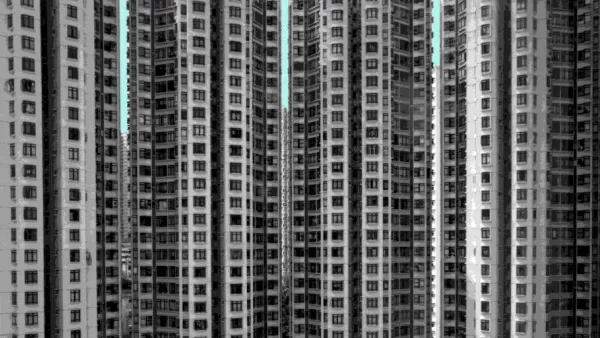
Friday Eye Candy: Built Environments Expanded Beyond Wildest Dreams
The work of Marcus Lyons replicates images of already sprawling human development to the breaking point and maybe beyond.
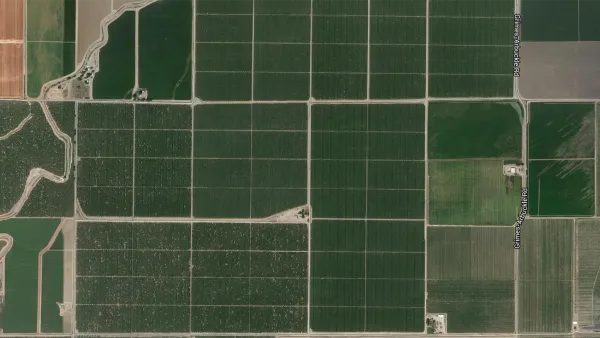
Friday Eye Candy: Where U.S. Roads Correct the Grid
Anyone who has traveled long country roads is familiar with the moment when a road makes a sharp turn to deviate from a direct path. Such "grid corrections" provide the subject for a photography project by Gerco de Ruijter.
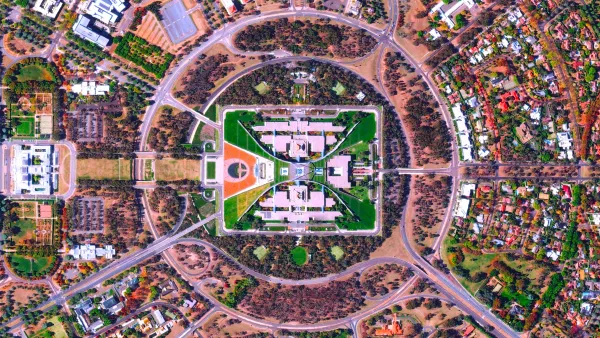
Looking for Inspiration? Try a Daily Dose of a Satellite's Perspective
Here's a strange idea that just might work: viewing the planet from afar might offer the perspective necessary to care for and protect our place in the universe.

Planetizen Federal Action Tracker
A weekly monitor of how Trump’s orders and actions are impacting planners and planning in America.

California plans to bury El Niño’s downpour
If the state plays its cards right, it may be able to store a billion acre-feet of El Niño’s water in aquifers.

Chicago breaks ground on $3 billion megadevelopment
The new neighborhood, titled Foundry Park, will one day host 3,700 residences.

One of Denver’s busiest corridors to gain BRT
The project will span 18 miles and contain 74 bus rapid transit stations.

275,000 bus trips are at stake on Seattle's ballot
If passed, the Seattle Transit Measure would trigger a 0.3% sales tax and raise an average of $138 million per year to maintain and expand Seattle’s bus services.

Texas may pay Israeli company billions to ease water woes
Texas awarded IDE Technologies the contract for its Harbor Island project, which is slated to become the Western Hemisphere's largest desalination plant.

FREE Course: Walkable City 1: Why Walkability?
After describing his path towards focusing on walkability as the essence of good planning, Jeff Speck marches through his five principal reasons for making more walkable places.
Reinventing Malls: Planning Alchemy—Turning Gray Fields Into Gold
The course focuses on the opportunities and imperatives that shape reinvention of mall sites.

City of Rosemead
Rutgers University, Edward J. Bloustein School of Planning and Public Policy
One Hundred Miles
Hunter College, City University of New York (CUNY)
The Architects Foundation
University of Cincinnati Online
City of Cambridge
Montrose County
The Pocatello Development Authority