The work of Marcus Lyons replicates images of already sprawling human development to the breaking point and maybe beyond.


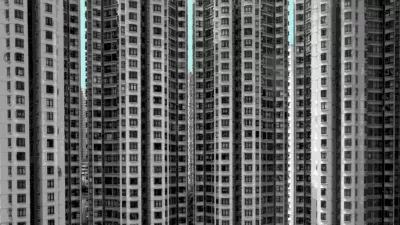
Kriston Capps shares the work of photographer Marcus Lyon, whose "works imagine end-state capitalism, just before the whole thing shuffles over the brink."
Or, put another way, "Using digital technology, the artist pushes various developments out to their logical conclusion, as if to warn people about what we are building—and demonstrate that it's already too late to stop."
And to be more location specific: "Lyon's photos combine the macro compositions of Andreas Gursky with the digital technique of Jörg Sasse and the subject-matter expertise of a Brookings Institution panel. He's done an entire series on BRICs, the emerging economies of Brazil, Russia, India, and China. Lyon does not picture BRIC cities how they are today, but rather—through aerial photography and digital retouching—what they could become in 10 or 20 years."
Capps concludes by musing on the implications of the images, including his mixed feelings about what kinds of development inspire optimism and which have a more sinister color.
Read the full story: Imagining the Chilling Landscape of Unchecked Global Development

Looking Down on Sprawl
Writing in The New York Times, Geoff Manaugh looks at Christoph Gielen's aerial photography of urban development and sprawl.
Friday Eye Candy: New York City, Minus the Cars and People
Johnny Simon shares the work of artist Marc Yankus, who created a series of images that remove people, cars, and animals from images of New York City.
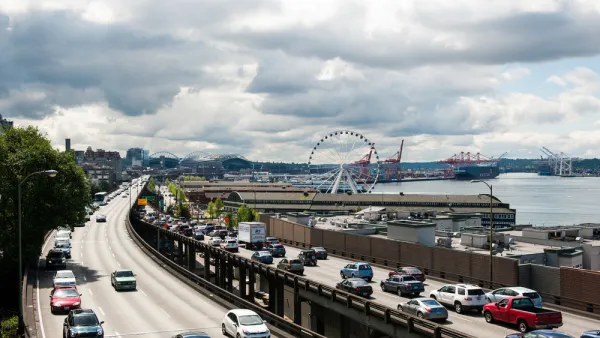
Friday Eye Candy: Painting to Memorialize Seattle's Alaskan Way Viaduct
Finding beauty, and questions, in the concrete.

Planetizen Federal Action Tracker
A weekly monitor of how Trump’s orders and actions are impacting planners and planning in America.

California plans to bury El Niño’s downpour
If the state plays its cards right, it may be able to store a billion acre-feet of El Niño’s water in aquifers.

Chicago breaks ground on $3 billion megadevelopment
The new neighborhood, titled Foundry Park, will one day host 3,700 residences.

One of Denver’s busiest corridors to gain BRT
The project will span 18 miles and contain 74 bus rapid transit stations.

275,000 bus trips are at stake on Seattle's ballot
If passed, the Seattle Transit Measure would trigger a 0.3% sales tax and raise an average of $138 million per year to maintain and expand Seattle’s bus services.

Texas may pay Israeli company billions to ease water woes
Texas awarded IDE Technologies the contract for its Harbor Island project, which is slated to become the Western Hemisphere's largest desalination plant.

FREE Course: Walkable City 1: Why Walkability?
After describing his path towards focusing on walkability as the essence of good planning, Jeff Speck marches through his five principal reasons for making more walkable places.
Reinventing Malls: Planning Alchemy—Turning Gray Fields Into Gold
The course focuses on the opportunities and imperatives that shape reinvention of mall sites.

City of Rosemead
Rutgers University, Edward J. Bloustein School of Planning and Public Policy
One Hundred Miles
Hunter College, City University of New York (CUNY)
The Architects Foundation
University of Cincinnati Online
City of Cambridge
Montrose County
The Pocatello Development Authority