Diana Powers reports that the cost of solar photovoltaic panels has declined "to the point where they are lower than the rising projected costs of new nuclear plants, according to a paper published this month."


Parity was reached at 16 cents per kilowatt hour. Solar electricity costs have been decreasing, while the costs of building new nuclear reactors has been rising "inexorably over the last eight years," said Mark Cooper, senior fellow for economic analysis at Vermont Law School's Institute for Energy and Environment.
"Despite the economic challenges, the nuclear power industry remains unfazed."
"This is not a hospitable environment in which to commission any large base-load power plant," said Marvin Fertel, president and chief executive of the Nuclear Energy Institute, in a briefing to the financial community. Still, he said: "Fortunately new nuclear plants won't be in service until 2016 or later, so today's market conditions are not entirely relevant."
Read the full story: Nuclear Energy Looses Cost Advantage

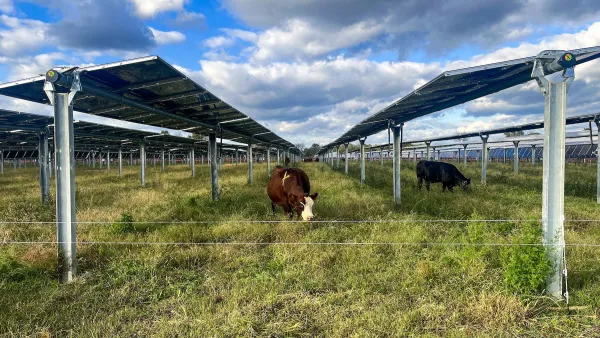
Cows at Tennessee's 'Silicon Ranch' graze under solar panels
The project aims to prove that agriculture and solar energy production can work in tandem.
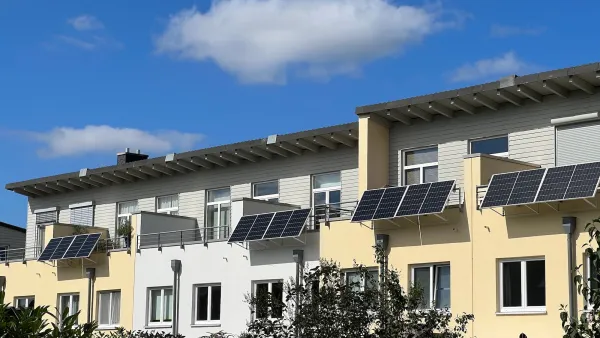
28 States and DC Could Legalize ‘Balcony Solar’
Plug-in solar panels, which are becoming popular across Europe, live in a regulatory gray area in the United States.
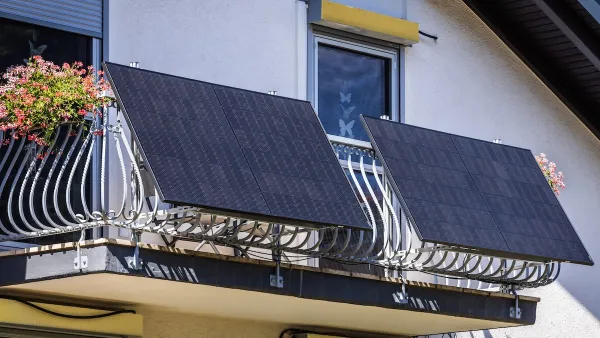
Bay Area Embraces ‘Balcony Solar’
Popular in Germany, wall- or balcony-mounted solar panels come at a lower cost and face fewer regulatory hurdles than rooftop solar, but their legal status in California is murky.

Planetizen Federal Action Tracker
A weekly monitor of how Trump’s orders and actions are impacting planners and planning in America.

Northwest rail fans eager for Sept. 30 debut of Amtrak’s Airo fleet
Get ready for that new train smell and more seats. But they won’t go faster or run more frequently on the Cascades route in Washington and Oregon.

Trump is considering data centers on 6 states' public land — some state officials say they had no idea
If the administration approves the proposed projects, data center and data center-related developments will cover 17,600 acres of public land.

After decades of planning, Sacramento gains new light rail station
Trains will arrive every 15 minutes during peak hours and every 30 minutes during non-peak hours.

Massive tunnel-boring machine breaks ground on Gateway Project
The Trump administration revoked funding for the project in October 2025, and then restored it earlier this year.

Airo trainsets begin service on Amtrak Cascades route
The trains feature panoramic windows, complementary wifi and over 300 seats per train set.

FREE Course: Walkable City 1: Why Walkability?
After describing his path towards focusing on walkability as the essence of good planning, Jeff Speck marches through his five principal reasons for making more walkable places.
Reinventing Malls: Planning Alchemy—Turning Gray Fields Into Gold
The course focuses on the opportunities and imperatives that shape reinvention of mall sites.

City of Thousand Oaks
City of Wisconsin Rapids
Harvard University Graduate School of Design
The Architects Foundation
University of Cincinnati Online
Northern Illinois Transit Authority (NITA)
The Pocatello Development Authority
The Urban Renewal Agency of the City of Pocatello