Former California Governor (and current gubernatorial candidate) Jerry Brown may be the only person able to give the state a clean energy policy -- mainly because he's already done it before, according to this article.


But despite energy successes during his last stint as head of the state, many challenges remain, including some new ones.
"Three decades on, California remains ahead of the country in energy efficiency. Its per-capita electricity usage has barely budged since Brown's time despite the proliferation of gadgetry and a fondness for McMansions. California also continues to lead on solar, although without the emphasis on solar hot water that Brown had envisioned.
But on wind, the Golden State has become the Bronze State. Texas leads the nation in wind power production, having passed California for the top spot several years ago-and, embarrassingly, California now also trails Iowa, a state one-third of its size. Very few wind farms-or biomass or geothermal facilities-have been built since Brown's time. Wind farms or other power plants can no longer be blithely sited on empty land in California-a partial legacy of the many birds that have perished at Altamont Pass."
Read the full story: Jerry Brown's Clean Energy Revolution
Court unfreezes $20B in federal climate grants
A U.S. Court of Appeals ruled that the Trump administration potentially violated the Inflation Reduction Act by attempting to claw back grants awarded under the Greenhouse Gas Reduction Fund program.
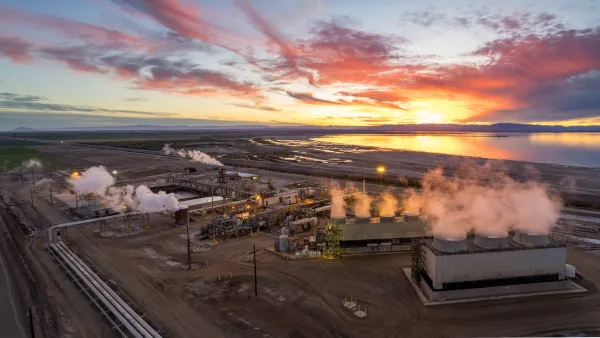
A desolate patch of Southern California desert could become a lithium powerhouse
Plans to develop lithium mines and data centers are dividing residents of a remote Southern California region.
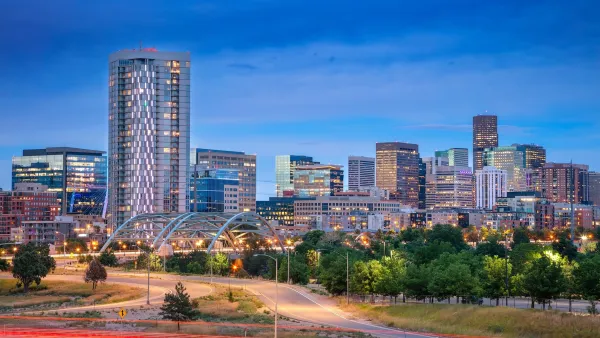
Denver is building a sewage-powered thermal energy network
A proposed thermal energy network will harness heat from the earth and from wastewater to power renewable heating and cooling systems.

Planetizen Federal Action Tracker
A weekly monitor of how Trump’s orders and actions are impacting planners and planning in America.

California plans to bury El Niño’s downpour
If the state plays its cards right, it may be able to store a billion acre-feet of El Niño’s water in aquifers.

Desperate measures: Advocates weigh draining Lake Powell to fill Colorado River
Draining the reservoir could reduce evaporation losses by a couple hundred thousand acre-feet.

US buildings threatened, destroyed by fires set to triple by 2060
Researchers found a high fire risk for socioeconomically vulnerable neighborhoods in the American West.

LA residents may be allowed to paint their own crosswalks
Councilwoman Katy Yaroslavsky put out a motion instructing the Los Angeles Department of Public Transportation to study the feasibility of allowing volunteers to paint crosswalks.

Dallas moves to overhaul its zoning code
The city's zoning reform will allow more multi-family and mixed-use developments.

FREE Course: Walkable City 1: Why Walkability?
After describing his path towards focusing on walkability as the essence of good planning, Jeff Speck marches through his five principal reasons for making more walkable places.
Reinventing Malls: Planning Alchemy—Turning Gray Fields Into Gold
The course focuses on the opportunities and imperatives that shape reinvention of mall sites.

City of Rosemead
Rutgers University, Edward J. Bloustein School of Planning and Public Policy
One Hundred Miles
Hunter College, City University of New York (CUNY)
The Architects Foundation
University of Cincinnati Online
City of Cambridge
Montrose County
The Pocatello Development Authority