Millions of American homeowners are underwater facing the loss of their home, causing devastating effects on the national and local economy. But when a homeowner decides to walk away from his or her home, is that a sign of crisis or a shrewd move?


This article digs deeper into the decision to 'walk away' from a home that is 'under water',or owing more on the loan than the home is worth. Is it a sensible choice, e.g. are there better ways to spend one's income? Turns out it may be as much a generational issue as it is an economic one.
From the Fresno Bee: "The latest generation of homeowners views real estate differently than their fathers and grandfathers. "Up until this decade, people bought a home because they wanted a place to raise their kids," Kane said. "They wanted good neighborhoods, good schools."
"Now, however, "What was an American dream became an asset to trade," he said. "There's no emotional attachment to an investment. ... And the older generations are perplexed by that attitude."
Thanks to AARP News
Read the full story: More California homeowners walk out on mortgages
Deciding Which Homeowners To Bail Out
The Feds have $1.5 billion to help homeowners at risk of losing homes to foreclosure. Deciding just which homeowners to help is no easy task. This article looks at the decision-making process in Arizona, one of the five states receiving federal aid.

San Joaquin Valley Struggles to Lower Emissions
The San Joaquin Valley has some of the worst air pollution and particulate matter emissions in the nation, but agricultural sources are loosely regulated.
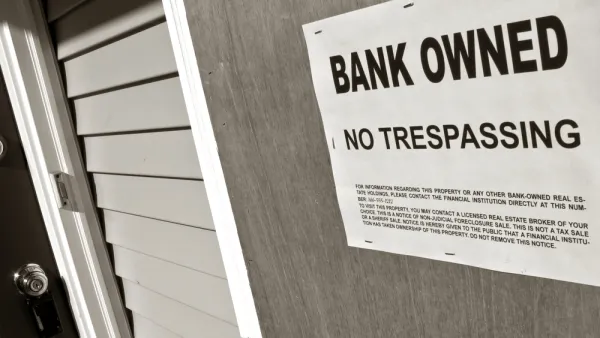
Federal Government Developing More Foreclosure Protections
Millions of American property owners are behind on mortgage payments and facing the prospect of foreclosure and eviction later this year.

Planetizen Federal Action Tracker
A weekly monitor of how Trump’s orders and actions are impacting planners and planning in America.

California plans to bury El Niño’s downpour
If the state plays its cards right, it may be able to store a billion acre-feet of El Niño’s water in aquifers.

Desperate measures: Advocates weigh draining Lake Powell to fill Colorado River
Draining the reservoir could reduce evaporation losses by a couple hundred thousand acre-feet.

Chicago voters approve permanent festival grounds, penalty for vacant property owners
Currently, major summer and fall festivals take over public parks for weeks at a time, drawing criticism from nearby residents

NYC votes to cut outdoor dining red tape, speed up permitting
New York City also voted to allow the Department of Transportation to begin work on urgent projects before notifying elected officials.

California appears to reject Prop. 45
The proposition would have expanded the projects that qualify for a streamlined environmental review, effectively paring down the California Environmental Quality Act.

FREE Course: Walkable City 1: Why Walkability?
After describing his path towards focusing on walkability as the essence of good planning, Jeff Speck marches through his five principal reasons for making more walkable places.
Reinventing Malls: Planning Alchemy—Turning Gray Fields Into Gold
The course focuses on the opportunities and imperatives that shape reinvention of mall sites.

City of Rosemead
Rutgers University, Edward J. Bloustein School of Planning and Public Policy
One Hundred Miles
Hunter College, City University of New York (CUNY)
The Architects Foundation
University of Cincinnati Online
City of Cambridge
Montrose County
The Pocatello Development Authority