DOT Secretary Ray LaHood is taped while speaking at a community meeting in Manhattan's Chinatown expressing enthusiasm for 'tolling', though it's not clear what roads or bridges would be tolled, which was clarified in a subsequent email.


LaHood explains to the meeting's attendees that because "people are driving less and are driving more fuel-efficient vehicles", the Highway Trust Fund, which receives revenue from fuel taxes, is running a deficit.
"In a discussion about what locals would like to see in the bill, LaHood became animated as he said "these are all good ideas." And then he added "The only problem we have in Washington, believe it or not, is finding the $600 billion to pay for it. " Pressed on sources of funding OTHER* than a gas tax, Lahood said: "Another way is -don't run me out, okay? Tolling. Some places in the country are talking about using tolls. You can raise a lot of money by tolling." The crowd, (a New York City crowd, after all), applauded."
The audio tape is available in the news article.
"Update: LaHood's spokeswoman, Jill Zuckman clarifies in an email: "He's not for tolling for existing roads already paid for by tax dollars. He's open to tolling to add capacity, like a new lane, or a new road."
*"For the Obama administration, deep-sixing the (transportation) bill was a political necessity, because raising the gas tax is a nonstarter in an election year. And until Oberstar or another lawmaker can find a viable alternative method to raise the $200 billion plus needed to fully fund his legislation, it is likely to stay stuck in no man's land." [Cited from Politico: James Oberstar stymied on transit bill
Ray LaHood is uttering a similar call for revenue as did his predecessor under the Bush Administration, Mary Peters, except she was far more specific about how to gain revenue from road tolling. [See Planetizen: 'Tolls Not Gas Tax', Says Bush.
Read the full story: LAHOOD: TOLLS CAN PAY FOR TRANSPORTATION BILL

Tensions Between House & Administration Stymie Transportation Progress
Tensions have arisen between the Obama administration and Oberstar, who is anxious to get working on the transportation reauthorization bill. DOT Secretary LaHood is calling for an extension of the 2005 highway bill instead.
The Future of National Surface Transportation Policy
That was the title the U.S. Senate Committee on Commerce, Science & Transportation chose for a hearing on April 28. Panelists: Ray LaHood, DOT Secretary; Steve Heminger, MTC; Jame Corless, T4America; Ann Canby, STPP, and Ned Holmes, TX Transp. Comm.
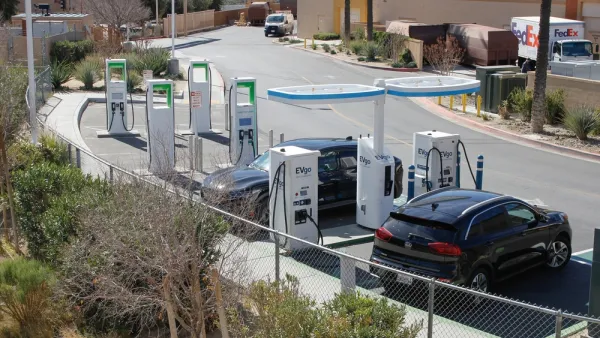
Electric Driving Is the Future; Now Is the Time to Price It
EVs are great, but they’re not perfect. Let’s end their free ride.

Planetizen Federal Action Tracker
A weekly monitor of how Trump’s orders and actions are impacting planners and planning in America.

Amtrak, CN end decades-long dispute with eight-year agreement
The new operating agreement establishes an updated framework for the companies to work together, including processes to resolve disputes.

Judges permit Denver to divert 77,000 acre feet from the Colorado River for reservoir expansion
Overuse and climate change have caused the Colorado River’s water levels to plummet.

Idaho may see an 18% drop in federal surface transit funding — the largest estimated cut in the US
Transit systems in rural communities are much more reliant on federal funding to provide their services.

How ‘post-disaster gentrification’ alters neighborhoods after natural calamities
After hurricanes, fires or other calamities, the original residents of a community are often replaced by younger, wealthier residents.

Maryland local governments examine if they should have more power to raise property taxes
Maryland’s housing market is out of reach for the majority of moderate-income residents.

FREE Course: Walkable City 1: Why Walkability?
After describing his path towards focusing on walkability as the essence of good planning, Jeff Speck marches through his five principal reasons for making more walkable places.
Reinventing Malls: Planning Alchemy—Turning Gray Fields Into Gold
The course focuses on the opportunities and imperatives that shape reinvention of mall sites.

Harvard University Graduate School of Design
KFH Group Inc.
Greater Baltimore Committee
The Architects Foundation
University of Cincinnati Online
The Pocatello Development Authority
The Urban Renewal Agency of the City of Pocatello