Despite being one of the largest cities in the U.S., public transit in Houston has not kept up with its population growth. Kristie Lewis offers five reasons why.


In addition to budgetary issues and local politics, Lewis suggests a lot of what's holding the city back is its attitude towards itself as a"car-dependent" place.
"Before any problem actually manifests itself, it has seeds in ideas. A major, almost ideological obstacle to improving Houston's public transportation is the enduring notion in this town (and the country at large) that one absolutely needs a car to be anybody, or to do anything. Is it true? Partially. And a lot of its truth stems from the layout of the city itself, as Houston is the only urban area in America with no formal zoning laws. However, George Washington University law student Michael Lewyn interestingly contests this notion, explaining that Houston's auto-dependence can be blamed on other factors as well. I believe that auto dependence in Houston has only become a self-fulfilling prophecy because of preconceived notions held about the city."
Read the full story: The Five Things Standing Between Houston and Effective Mass Transit

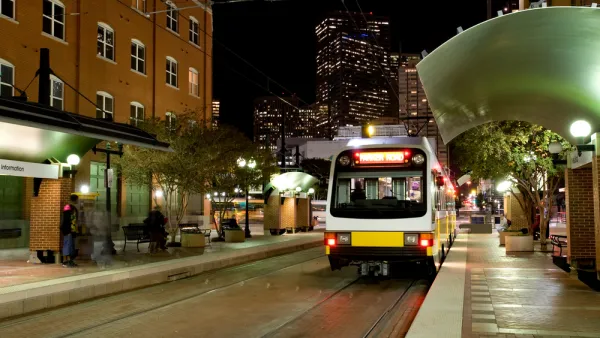
Houston Transit Barely Beats Out Dallas for Ridership
Out of the top five U.S. metro areas, Houston's transit ridership is second-lowest only to Dallas.
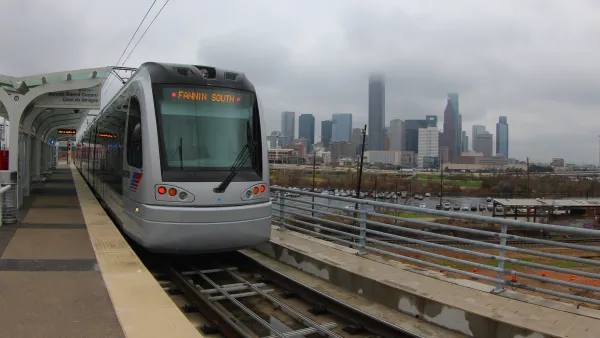
Houston Needs More Public Transit Funding, Report Finds
While ridership dropped during the pandemic, many 'essential workers' continued to rely on Houston Metro's services, signaling the crucial role of public transit for the city's economy.

Houston Transit Agency Moves Forward With Long-Range Plan Even as Revenue Falls
Despite reduced ridership during the COVID-19 pandemic, Houston Metro is pushing ahead with its $7.5 billion long-range transit plan.

Planetizen Federal Action Tracker
A weekly monitor of how Trump’s orders and actions are impacting planners and planning in America.

The state-sanctioned urbicide of Austin
People don’t kill cities. Freeways do.

Colorado’s Largest Data Center Could Rise Next to Homes — Without a Public Hearing
The proposed campus would consume 11 times the power of Denver International Airport; as it has across the country, opposition mounts.

Data centers are consuming nearly 25% of Oregon’s power
The state has 111 data centers, with 32 more either planned or under construction.

A third of Texas cities must update their zoning codes to comply with new housing law
Texas municipalities are now required to allow manufactured housing in at least one residential zoning district.

Nation's most wind-powered state turns to coal as data centers increase energy demand
For the first time in decades, Iowa has increased its generation of coal power.

FREE Course: Walkable City 1: Why Walkability?
After describing his path towards focusing on walkability as the essence of good planning, Jeff Speck marches through his five principal reasons for making more walkable places.
Reinventing Malls: Planning Alchemy—Turning Gray Fields Into Gold
The course focuses on the opportunities and imperatives that shape reinvention of mall sites.

Greater Baltimore Committee
Eagle County Government
Harvard University Graduate School of Design
The Architects Foundation
University of Cincinnati Online
The Pocatello Development Authority
The Urban Renewal Agency of the City of Pocatello
Journal of the American Planning Association