Shanghai is preparing for the 2010 World Expo, but the Chinese investment won't create anything like the urban investment created in Vancouver for the Olympics, says Brendon Crain.


Crain writes, "Expo 2010 will leave an indelible mark on the city, with the Chinese government pouring $45 billion into not just the site of the festival, but to neighborhood infrastructure and a transit system expansion that would make any mayor's face turn a vivid shade of green: the city has added six-count 'em-six new subway lines in preparation. But even with all of that, one can't help feeling like a rare opportunity to build a unique urban model for the future may have been lost (especially considering the expo's theme, "Better city, better life,") since most of the buildings will wind up recycled into more standard fare or, worse still, demolished completely, their materials wasted."
Read the full story: The Non-Legacy of the 2010 Expo


Budget constraints threaten light rail for Oregon, Washington’s new bridge
The current proposal includes only the infrastructure for the light rail, without funding for the train and tracks.
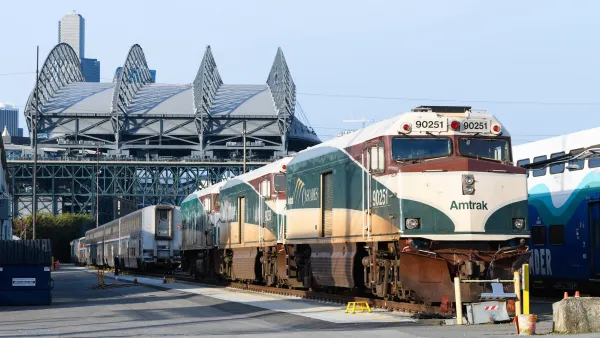
Amtrak opens border preclearance facility for travelers entering US from Vancouver
The first-of-its-kind facility streamlines the border crossing experience, eliminating long waits.

Vancouver Set to Adopt Game-changing Citywide Development Plan
To comply with new provincial law, Vancouver will adopt a new city plan aimed at guiding development for the next three decades.

Planetizen Federal Action Tracker
A weekly monitor of how Trump’s orders and actions are impacting planners and planning in America.

Northwest rail fans eager for Sept. 30 debut of Amtrak’s Airo fleet
Get ready for that new train smell and more seats. But they won’t go faster or run more frequently on the Cascades route in Washington and Oregon.

Trump is considering data centers on 6 states' public land — some state officials say they had no idea
If the administration approves the proposed projects, data center and data center-related developments will cover 17,600 acres of public land.

California high-speed rail accomplishes only one legislative goal in 2026
The majority of the agency's failed pitches were never developed into written proposals.

Sharp cuts to federal passenger rail, public transit funding arrive today
The American Public Transportation Associations estimates the stopgap bill will result in an over 80% cut to federal passenger rail investment and 20% cut to public transit investment.

Chicago to showcase country’s first battery-operated passenger train
Metra estimates the trains will be ready for passenger use around the start of 2028.

FREE Course: Walkable City 1: Why Walkability?
After describing his path towards focusing on walkability as the essence of good planning, Jeff Speck marches through his five principal reasons for making more walkable places.
Reinventing Malls: Planning Alchemy—Turning Gray Fields Into Gold
The course focuses on the opportunities and imperatives that shape reinvention of mall sites.

City of Thousand Oaks
City of Wisconsin Rapids
Harvard University Graduate School of Design
The Architects Foundation
University of Cincinnati Online
Northern Illinois Transit Authority (NITA)
The Pocatello Development Authority
The Urban Renewal Agency of the City of Pocatello