Metropolitan officials in the Sun Corridor of Arizona are increasingly working together to form a self-organized super-region, according to this analysis.


These communities are taking their lead from cities in the Intermountain West, where inter-metropolitan self-organization has resulted in such projects as the Denver area's FasTracks rail system.
"Now the sometimes fractious Sun Corridor of Arizona has become a hot spot of self-organized super-regionalism. Putting aside petty inter-metropolitan rivalries, leaders from Phoenix, Tucson, and other locales in the Arizona urban super-zone have increasingly been finding ways to work together--though not by fiat from some higher authority.
Prime past examples of the new spirit include the new joint University of Arizona-Arizona State University (ASU) Medical School in downtown Phoenix and the nationally significant Science Foundation Arizona (SFAz) initiative. SFAz--initiated in the spring of 2006 by the three statewide CEO groups, the Flagstaff 40, Greater Phoenix
Leadership, and Southern Arizona Leadership Council--represents a unique multi-metro public/private push to make serious investments in the region's innovation capacity."
Read the full story: Self-Organizing the Sun Corridor

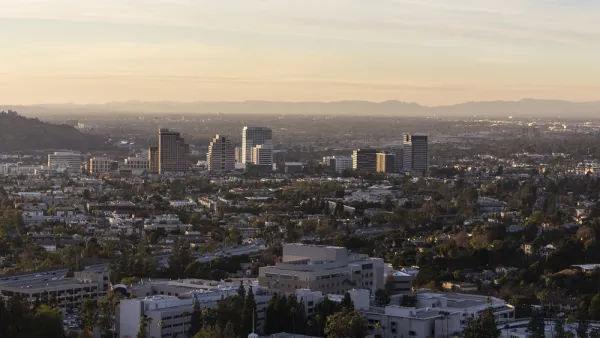
Misunderstanding Metros
The vernacular notion of "metro area" or "urban region" may not match up with standard political designations, like municipality, county, state, or city-state. Too bad. Ambiguity and complexity are hallmarks of today's mega-cities.
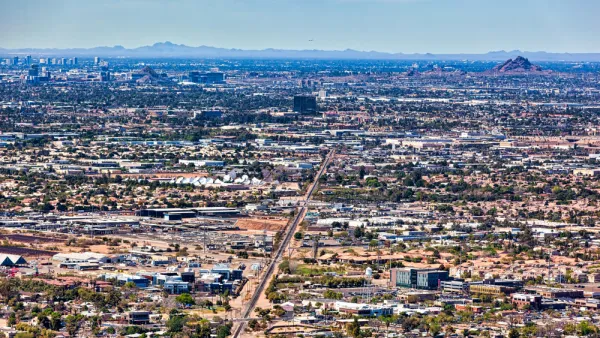
Predictions That Phoenix and Tucson Will Merge Revisited
Before the recession, bumper Arizona home sales led to predictions that the state's two largest cities might merge by 2040. The downturn stalled those forecasts, but now they're being revisited.
Metro Job Generators
Regional business planning and cooperation at the metropolitan level is creating hubs of prosperity in the U.S.

Planetizen Federal Action Tracker
A weekly monitor of how Trump’s orders and actions are impacting planners and planning in America.

Chicago breaks ground on $3 billion megadevelopment
The new neighborhood, titled Foundry Park, will one day host 3,700 residences.

Denver is solving homelessness. Why aren't the rest of us?
Since 2023, Denver's street homeless population has decreased by 64%, proving that effective tools exist to support those in need of housing.

MTA kicks off six-year, $1 billion transit upgrade project
The authority is replacing the roughly 90-year-old train signals on the A and C line with modern technology.

Developers may expand largest gas pipeline network in Northwest
Pipeline giant Williams has proposed new expansions for its Northwest Pipeline from the Colorado Rockies through Idaho, Oregon and Washington.

MBTA is using AI to catch drivers who park illegally
The transit agency is working in partnership with Hayden AI, and hopes the technology will improve transit safety across its network.

FREE Course: Walkable City 1: Why Walkability?
After describing his path towards focusing on walkability as the essence of good planning, Jeff Speck marches through his five principal reasons for making more walkable places.
Reinventing Malls: Planning Alchemy—Turning Gray Fields Into Gold
The course focuses on the opportunities and imperatives that shape reinvention of mall sites.

City of Rosemead
Rutgers University, Edward J. Bloustein School of Planning and Public Policy
One Hundred Miles
The Architects Foundation
University of Cincinnati Online
Montrose County
Northern Illinois Transit Authority (NITA)
The Pocatello Development Authority