As homelessness rises in cities and suburbs across the country, local municipalities are trying to get the newly homeless back into homes as quickly as they can.


"They're redoubling their efforts on an approach known as 'rapid re-housing,' the idea that the best way to help homeless people is to place them in independent, permanent housing as soon as possible. Rather than providing beds in shelters and mandating counseling or other community services, the rapid re-housing approach is based on a simple notion: The cause of homelessness is the lack of housing. That's it. Help someone secure a home, and they're no longer homeless. All other services - job help, childcare, drug or alcohol counseling - can be dealt with more easily once you've moved into your own home, says Nan Roman, president and CEO of the National Alliance to End Homelessness. 'Homelessness is not a lifestyle,' she says. 'It's a crisis. And we should remedy it as quickly as we can.'"
This "housing first" model is being adopted by cities across the country, though some residents remain skeptical that the investment in permanent housing will have an impact on what seems to be a ubiquitous problem.
Read the full story: Stemming the Tide of Homelessness
Halfway Towards Ending Homelessness in Portland
Portland, Oregon is half-way through its ten-year plan to address homelessness. The city's seen improvements, but many challenges lie ahead, according to this report.

HUD: US homelessness grew by 27% since 2013
Despite the alarming increase in unhoused Americans, HUD is asking for a budget reduction.
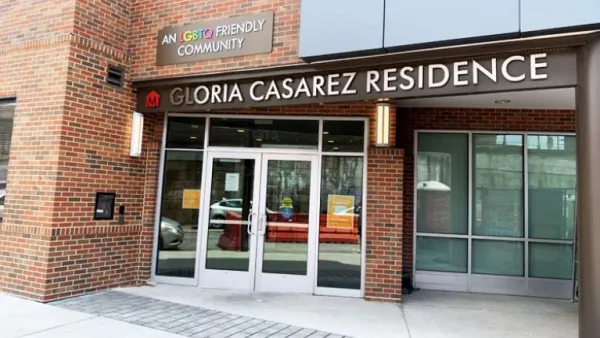
Philadelphia Supportive Housing Providers Brace for 'Misguided' Loss of Tens of Million in Federal Funds
A shift in focus from ‘Housing First’ policies to more restrictive approaches to homelessness could eliminate funding for long-term housing providers.

Planetizen Federal Action Tracker
A weekly monitor of how Trump’s orders and actions are impacting planners and planning in America.

California plans to bury El Niño’s downpour
If the state plays its cards right, it may be able to store a billion acre-feet of El Niño’s water in aquifers.

Desperate measures: Advocates weigh draining Lake Powell to fill Colorado River
Draining the reservoir could reduce evaporation losses by a couple hundred thousand acre-feet.

Mamdani’s pied-à-terre tax survives legal challenge
A panel of judges found that the plaintiffs failed to demonstrate injury as a result of New York City's implementation of the tax.

Eastern Nebraska is running out of electricity
Data centers and electrification are straining eastern Nebraska’s grid, throttling economic development.

Seattle passes record-breaking transit services expansion
Proposition 1 will double the city’s transit tax to add 95,000 more bus trips and preserve 180,000 bus trips annually.

FREE Course: Walkable City 1: Why Walkability?
After describing his path towards focusing on walkability as the essence of good planning, Jeff Speck marches through his five principal reasons for making more walkable places.
Reinventing Malls: Planning Alchemy—Turning Gray Fields Into Gold
The course focuses on the opportunities and imperatives that shape reinvention of mall sites.

City of Rosemead
Rutgers University, Edward J. Bloustein School of Planning and Public Policy
One Hundred Miles
University of Michigan School for Environment and Sustainability (SEAS)
Hunter College, City University of New York (CUNY)
The Architects Foundation
City of Cambridge
Montrose County
The Pocatello Development Authority