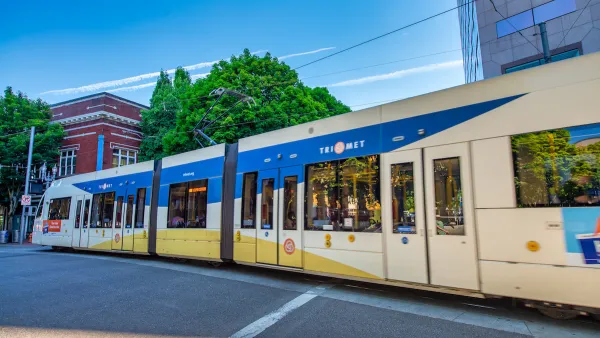
Residents and visitors to downtown Portland have long enjoyed taking buses, LRT, and streetcar within a perimeter known as Fareless Square at no cost. While the MAX and streetcar will remain 'fareless', the bus will cost you. New name: Free Rail Zone


While the elimination of the free, downtown bus service may be missed by some, it will, according to TriMet, make taking the bus "less confusing" since most buses go beyond the free area. However, the same can be said of the Light Rail Transit known as MAX.
Fareless Square "was created in 1975 to reduce emissions and auto traffic in the downtown area. Though it has attracted transit users, the square has been faulted for encouraging crime and annoyances on buses and trains. It also made it difficult to collect fares from bus riders who may board in Fareless Square but continue on beyond the zone."
From TriMet:
"The Free Rail Zone includes most of downtown Portland (within the boundaries of the Willamette River, NW Irving and I-405), as well as MAX stations from the Rose Quarter to Lloyd Center. Look for Free Rail Zone emblems at rail stations within these boundaries."
From Why we changed Fareless Square to the Free Rail Zone, August 2009:
"This summer, we held open houses and asked for public feedback on the rail-only proposal, resulting in more than 600 comments. 51% supported changing Fareless Square to rail-only, while 21% wanted to keep it as-is, 11% supported eliminating it completely, and 9% wanted to keep a fare-free zone in some form."
Thanks to Ed Braddy
Read the full story: Beginning Sunday, buses are no longer free in downtown Portland


Portland gathers to pay respects to the last of its original light rail cars
The TriMet agency has fully replaced its aging fleet of Type 1 cars.
Portland Train Speed Limited by Extreme Heat
When temperatures hit 100 degrees, the city’s two train systems face challenges that force them to slow their speeds or stop operations altogether.
Big Business in Portland Doesn't Want to Pay for Metro Transportation Funding Measure
A heated dispute over a $5 billion Metro transportation funding ballot measure has erupted between climate activists and a group representing Portland's big business interests.

Planetizen Federal Action Tracker
A weekly monitor of how Trump’s orders and actions are impacting planners and planning in America.

Northwest rail fans eager for Sept. 30 debut of Amtrak’s Airo fleet
Get ready for that new train smell and more seats. But they won’t go faster or run more frequently on the Cascades route in Washington and Oregon.
Alabama scores up to $2.5 billion federal loan for largest infrastructure project in state’s history
The Mobile River Bridge and Bayway Project aims to ease congestion at Alabama’s worst bottleneck.

Novel study finds extreme state-by-state disparity in housing construction timelines
The first comprehensive working paper on U.S. construction timelines also found that the permitting process for multi-family projects has slowed nationwide.

California may destroy its beaches trying to save homes from El Niño
Boulders and seawalls can protect homes from waves, but ultimately destroy sandy beaches.

California high-speed rail accomplishes only one legislative goal in 2026
The majority of the agency's failed pitches were never developed into written proposals.

FREE Course: Walkable City 1: Why Walkability?
After describing his path towards focusing on walkability as the essence of good planning, Jeff Speck marches through his five principal reasons for making more walkable places.
Reinventing Malls: Planning Alchemy—Turning Gray Fields Into Gold
The course focuses on the opportunities and imperatives that shape reinvention of mall sites.

City of Thousand Oaks
City of Wisconsin Rapids
Harvard University Graduate School of Design
The Architects Foundation
University of Cincinnati Online
Northern Illinois Transit Authority (NITA)
The Pocatello Development Authority
The Urban Renewal Agency of the City of Pocatello