After being accused of being party-unfriendly, Paris and other French cities have been officially allowed to keep their dance clubs open as late as 7 a.m.


"An Internet petition warns that the City of Light has become "Europe's capital of sleep" -- and complains that musicians, DJs and partiers are heading instead to London, Barcelona, Prague and Berlin.
In a bid to bring them back, government proclaimed last weekend that dance clubs across France can now stay open until 7 a.m., later than has been allowed in many parts of the country."
Some officials hope the extended hours will help French cities regain their status as party spots, and reduce late-night binge drinking on the streets after the clubs close.
Read the full story: New French decree: Party 'til dawn!
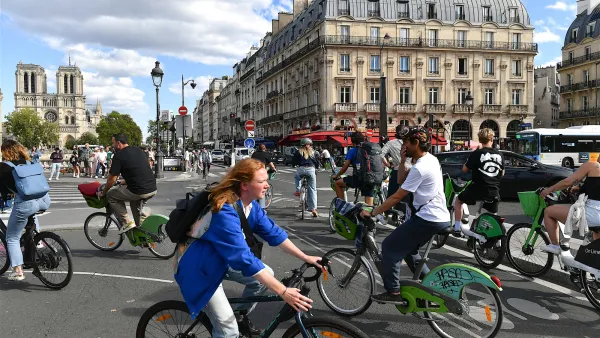
Biking in Paris grew by 240% in 5 years
The city saw a significant rise in bike use thanks to data-driven policy changes.

Paris Opens Europe’s Longest Aerial Gondola Line
The new cable car line, France’s seventh, is expected to carry roughly 11,000 passengers per day.

France Tightens Restrictions on Short-Term Rentals
The vacation rental market is shouldering part of the blame for rising housing costs, particularly in popular tourist destinations.

Planetizen Federal Action Tracker
A weekly monitor of how Trump’s orders and actions are impacting planners and planning in America.

Eastern Nebraska is running out of electricity
Data centers and electrification are straining eastern Nebraska’s grid, throttling economic development.

Washington state to charge fee to drivers with fuel-efficient cars
Revenue from the fee will go towards supporting the state’s highways.

How a Massachusetts city used laser beams to find the root of its tree loss
Cambridge discovered that the most tree loss was occurring on residential lots rather than city-owned property.

Instead of building new housing, LA developers are turning mansions into mega-mansions
In the richest areas, the number of houses valued at $30 million with demolition permits has skyrocketed since 2018.

Illinois considers spending $1 billion in taxpayer money on data center
A quantum computing campus and data center are currently under construction in Chicago.

FREE Course: Walkable City 1: Why Walkability?
After describing his path towards focusing on walkability as the essence of good planning, Jeff Speck marches through his five principal reasons for making more walkable places.
Reinventing Malls: Planning Alchemy—Turning Gray Fields Into Gold
The course focuses on the opportunities and imperatives that shape reinvention of mall sites.

City of Charlotte
City of Rosemead
Rutgers University, Edward J. Bloustein School of Planning and Public Policy
University of Michigan School for Environment and Sustainability (SEAS)
Hunter College, City University of New York (CUNY)
The Architects Foundation
University District Partnership
City of Cambridge
The Pocatello Development Authority