A critical look at the football stadium proposed for outside Los Angeles, called "green" architecture, but it seems the costs will far outweigh its benefits.


"Though we often forget or sidestep this fact, the same qualities that make a piece of land ideal for development aiming to attract visitors from across a broad area in Southern California - easy freeway access, wide-open spaces, precious few pesky neighbors - also tend to make it a kind of planning black hole, a site that has little chance of succeeding in urban terms in any but the most circumscribed sense."
"Clearly the greenest approach, if hardly the easiest politically, would be to adapt the Rose Bowl or the Coliseum rather than build a massive new facility, no matter how smartly engineered, from scratch. Even a new stadium on the edge of the Dodger Stadium parking lot, an option Frank McCourt reportedly considered, would be greener than the City of Industry plan, simply because it would use a new NFL facility as a mechanism for the kind of large-scale infill development Los Angeles needs."
Read the full story: Should we buy into the dream of a football stadium in City of Industry?
How Will L.A.'s New Inglewood Football Stadium Revitalize South Los Angeles?
The Los Angeles Rams COO details both the stadium's sustainable design and the positive impact the privately funded complex will have on Southern California.
Two CEQA-Reform Bills Signed By Governor
Brown's main reason for signing the bills: "Too Damn Many Regulations". One gives environmental clearance for the AEG stadium in downtown LA, and the other other accelerates environmental review for projects costing at least $100 million.
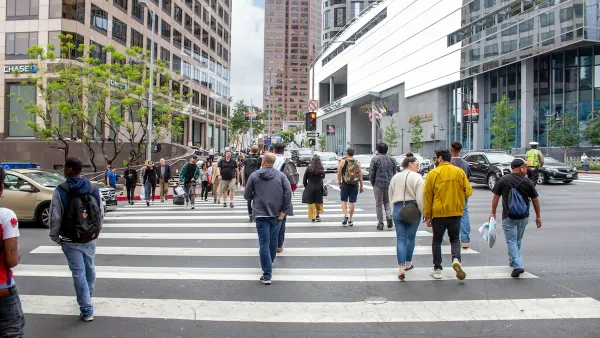
LA residents may be allowed to paint their own crosswalks
Councilwoman Katy Yaroslavsky put out a motion instructing the Los Angeles Department of Public Transportation to study the feasibility of allowing volunteers to paint crosswalks.

Planetizen Federal Action Tracker
A weekly monitor of how Trump’s orders and actions are impacting planners and planning in America.

California plans to bury El Niño’s downpour
If the state plays its cards right, it may be able to store a billion acre-feet of El Niño’s water in aquifers.

Desperate measures: Advocates weigh draining Lake Powell to fill Colorado River
Draining the reservoir could reduce evaporation losses by a couple hundred thousand acre-feet.

Mamdani’s pied-à-terre tax survives legal challenge
A panel of judges found that the plaintiffs failed to demonstrate injury as a result of New York City's implementation of the tax.

Eastern Nebraska is running out of electricity
Data centers and electrification are straining eastern Nebraska’s grid, throttling economic development.

Seattle passes record-breaking transit services expansion
Proposition 1 will double the city’s transit tax to add 95,000 more bus trips and preserve 180,000 bus trips annually.

FREE Course: Walkable City 1: Why Walkability?
After describing his path towards focusing on walkability as the essence of good planning, Jeff Speck marches through his five principal reasons for making more walkable places.
Reinventing Malls: Planning Alchemy—Turning Gray Fields Into Gold
The course focuses on the opportunities and imperatives that shape reinvention of mall sites.

City of Rosemead
Rutgers University, Edward J. Bloustein School of Planning and Public Policy
One Hundred Miles
University of Michigan School for Environment and Sustainability (SEAS)
Hunter College, City University of New York (CUNY)
The Architects Foundation
City of Cambridge
Montrose County
The Pocatello Development Authority