Denver's FasTracks light rail system was set to be the nation's most aggressively constructed transit system when it was approved in 2004. But five years into the 12 year plan, budget issues and delays are calling the system's future into question.


Originally planned under a budget of $4.7 billion, the 122-mile system is seeing costs rise and timelines fade.
"Projected costs have ballooned to nearly $7 billion, and the system faces a budget gap of $2.2 billion, mainly because of a sharp drop in sales tax revenues. Worse still, most rail lines are still on the drawing board, and the 10,000 or so workers needed when construction reaches full swing beginning in 2011 have not yet been hired, muting the economic stimulus.
Voters could be presented with a proposed sales tax increase as early as next year to finish a system that remains mostly an idea."
Read the full story: Grand Plans for Rail in Denver Hit a Wall of Fiscal Realities
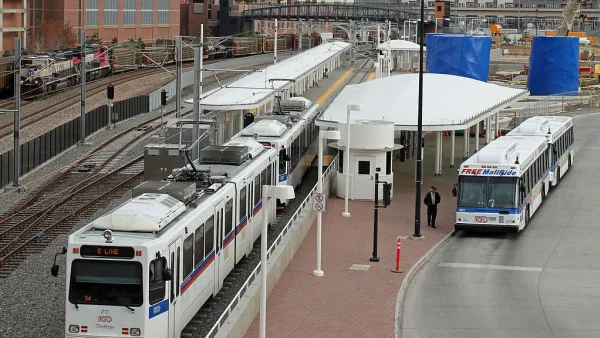
Denver Faces Light Rail vs. Bus Decision
The financial data is clear: BRT costs much less to go further and serve far more riders. Case closed, or is it? The Denver Post editors look at HNTB's cost and ridership estimates for the Northwest Rail Line and offer a recommendation, sort of.
First Leg of Denver's Multi-Billion Dollar Transit Expansion Set to Open Next Month
After passing a trial run with few problems this week, Denver's 12.1-mile West Rail Line is set to open to the public next month.
Denver Area Considers Sales Tax Boost for Light Rail
Denver's transit agency is considering a plan to ask voters to make a further increase to the county's sales tax in order to fund the region's FasTracks light rail system.

Planetizen Federal Action Tracker
A weekly monitor of how Trump’s orders and actions are impacting planners and planning in America.

Eastern Nebraska is running out of electricity
Data centers and electrification are straining eastern Nebraska’s grid, throttling economic development.

Study reveals best places in the U.S. for cycling, walking
New research from Streetlight Data examines bicycle and pedestrian miles per capita in the 100 largest U.S. cities by population.

San Antonio is using environmental review to stall ICE detention center
San Antonio sued last month to pause work on the new detention center until the federal government studied its effect on the surrounding area.

Austin plans light rail extension — before breaking ground on light rail
The planned extension is three miles long and will take riders straight to Austin-Bergstrom International Airport.

Chicago cuts ribbon on $300,000, self-cleaning public toilet
The public toilet is the city’s first, and may pave the way for a rollout of similar facilities.

FREE Course: Walkable City 1: Why Walkability?
After describing his path towards focusing on walkability as the essence of good planning, Jeff Speck marches through his five principal reasons for making more walkable places.
Reinventing Malls: Planning Alchemy—Turning Gray Fields Into Gold
The course focuses on the opportunities and imperatives that shape reinvention of mall sites.

City of Charlotte
City of Rosemead
Rutgers University, Edward J. Bloustein School of Planning and Public Policy
University of Michigan School for Environment and Sustainability (SEAS)
Hunter College, City University of New York (CUNY)
The Architects Foundation
City of Cambridge
The Pocatello Development Authority
The Urban Renewal Agency of the City of Pocatello