The current government strategy to increase fuel efficiency is to mandate it through increases in the Corporate Average Fuel Economy standards, currently set for 35.5 mpg by 2016. In this piece, auto executives suggest a better way - using gas taxes.


When gas topped $4 a gallon, Priuses were not to be found on any of Toyota's lots. Now, not only are plenty of hybrids available, but light trucks are once again outselling the more fuel-efficient passenger cars.
"Mike Jackson, CEO of AutoNation, the largest automotive retail group in the U.S, suggests steadily increasing the gas tax until a gallon costs between $4 and $5 per gallon -- still far less than the price of gas in Europe. Jerry York, a former GM board member, agreed with Jackson's point. Both agree that the key is to gradually increase the fuel tax to slowly increase fuel prices..."
"What you have to do is to it in a manner that is slow enough and predictable enough that vehicle selection and choices by people over the cycle can be made in a logical way," said Tim Leuliette, CEO of parts supplier Dura Automotive."
From "Gasoline Price Causing Big-Vehicle Sales": "When the average gasoline price is $2.66 a gallon, according to news reports on the most recent Lundberg Survey, the message to the consumer is "Buy that big vehicle."
Thanks to Patricia Matajcek
Read the full story: Auto Executives Believe Raising Gas Tax Best Way to Increase Fuel Economy


Planetizen Federal Action Tracker
A weekly monitor of how Trump’s orders and actions are impacting planners and planning in America.

Northwest rail fans eager for Sept. 30 debut of Amtrak’s Airo fleet
Get ready for that new train smell and more seats. But they won’t go faster or run more frequently on the Cascades route in Washington and Oregon.
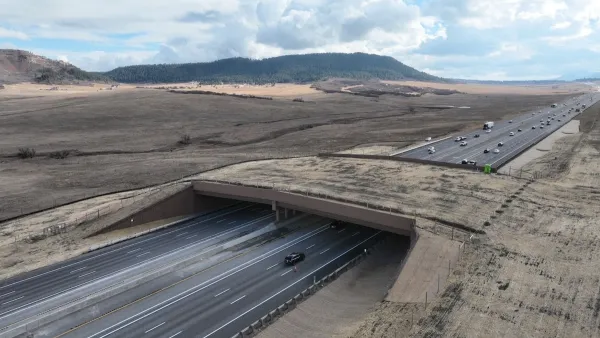
Record-breaking wildlife overpass in Colorado brings 91% reduction in animal collisions
Prior to the overpass, vehicles were hitting one deer per day on Colorado’s Interstate 25.

Detroit to transform waterfront with $2.2 billion investment
Developers will convert about 18 acres of unused parking lot space into civic spaces.

‘Going backwards:’ Baltimore mayor, students rally against state's transit funding plan
Maryland's proposed six-year plan provides no funding for Baltimore’s BMORE bus program and reduces its road maintenance funding.

Trump wants to cancel nearly 98% of funding for HUD housing support program
Multiple housing groups are suing the administration in an effort to preserve the funding.

FREE Course: Walkable City 1: Why Walkability?
After describing his path towards focusing on walkability as the essence of good planning, Jeff Speck marches through his five principal reasons for making more walkable places.
Reinventing Malls: Planning Alchemy—Turning Gray Fields Into Gold
The course focuses on the opportunities and imperatives that shape reinvention of mall sites.

City of Thousand Oaks
City of Wisconsin Rapids
Harvard University Graduate School of Design
The Architects Foundation
University of Cincinnati Online
Northern Illinois Transit Authority (NITA)
The Pocatello Development Authority
The Urban Renewal Agency of the City of Pocatello