Boston has not had a good relationship with cyclists. However, Mayor Thomas M. Menino is a cycling advocate, a city bike czar is on staff, bike lanes and facilities have been added, and a turn-around is evident even to its critics.


Boston was tagged "one of the nation's 'Worst Biking Cities' three times from 1999 to 2006". It's trying to change that image. Four miles of bike lanes have been added; five to ten are due to be added by years end, and laws have been added to make cycling safer as the city tries to compete with its bike-friendly neighbor, Cambridge.
"The grand plan is to change the culture, which is an incredible task," said Nicole Freedman, a former Olympic cyclist who was hired as the city's "bike czar" in 2007."
"Even Bicycling Magazine is cutting Boston some slack, putting it on last year's "Five for the Future" list."
However, it may not be moving fast enough.
"David Watson, executive director of MassBike, an advocacy organization, said change in Boston, particularly in the number of miles of bike lanes put in each year, is slow compared with improvements in other cities."
Thanks to Benjamin Boshnack
Read the full story: Boston Tries to Shed Longtime Reputation as Cyclists’ Minefield
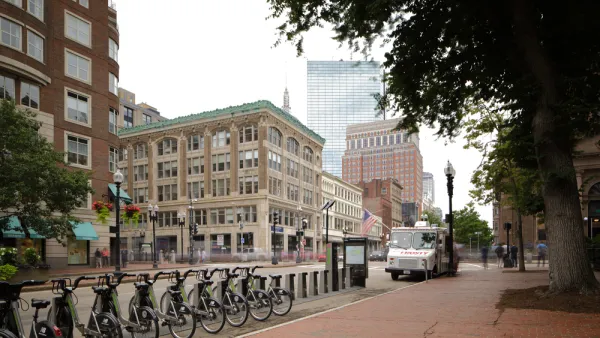
Boston Installs New Bike Lanes as Part of GoBoston 2030 Initiative
The city wants to cut its car use in half by 2030 as part of an aggressive set of "aspirational" goals.
America's Best Bike Cities
With gas prices at an all time high, bike riding has never looked better. Shermans Travel identifies the top cities to bike through, noting a bounty of amenities to save on costs for the urban biker.
Boston's Transit Achieves New Balance with Bike-Sharing Program
Mayor Thomas Menino declared that "the car is no longer king in Boston" as the Hubway bike-sharing system made its debut this week, putting the city abreast with Washington D.C.

Planetizen Federal Action Tracker
A weekly monitor of how Trump’s orders and actions are impacting planners and planning in America.

California plans to bury El Niño’s downpour
If the state plays its cards right, it may be able to store a billion acre-feet of El Niño’s water in aquifers.

Desperate measures: Advocates weigh draining Lake Powell to fill Colorado River
Draining the reservoir could reduce evaporation losses by a couple hundred thousand acre-feet.

Los Angeles just elected an urban planner as its mayor
Transportation analysts are optimistic that Raman will be more aggressive in addressing transit issues than Bass.

Mamdani’s pied-à-terre tax survives legal challenge
A panel of judges found that the plaintiffs failed to demonstrate injury as a result of New York City's implementation of the tax.

Eastern Nebraska is running out of electricity
Data centers and electrification are straining eastern Nebraska’s grid, throttling economic development.

FREE Course: Walkable City 1: Why Walkability?
After describing his path towards focusing on walkability as the essence of good planning, Jeff Speck marches through his five principal reasons for making more walkable places.
Reinventing Malls: Planning Alchemy—Turning Gray Fields Into Gold
The course focuses on the opportunities and imperatives that shape reinvention of mall sites.

City of Rosemead
Rutgers University, Edward J. Bloustein School of Planning and Public Policy
One Hundred Miles
University of Michigan School for Environment and Sustainability (SEAS)
Hunter College, City University of New York (CUNY)
The Architects Foundation
City of Cambridge
Montrose County
The Pocatello Development Authority