Miami, Broward, and Palm Beach counties are unable to sustain their financial contributions to Tri-Rail, so weekend service will end and major cuts made to daily service.


Board members of South Florida Regional Transportation Authority approved a draconian budget for Tri-Rail: "reducing service from 50 trains daily to 30, ending weekend and holiday runs and completely shutting down the system by early 2011."
"Officials also disclosed that the Federal Transit Administration is threatening to demand the return of $256 million Tri-Rail used for adding a second track -- if service is cut below 48 trains a day."
Ironically, the fiscal crunch hits as the train is capturing new riders with hopes for expansion.
The commuter train serving Broward, Miami-Dade and Palm Beach counties has seen its ridership double in the past three years, and plans include extending it to Martin County, if funds can be found.
"This is the first time in the system's 20-year history that officials are seriously considering ending the service -- formally started in 1989."
"Counties were planning to reduce contributions to the required minimums of about $4.2 million per county -- instead of the $7 million per county under existing levels.
''The counties will no longer be funding this agency at the same level,'' said Broward County Commissioner Josephus Eggelletion, who also serves as chairman of the South Florida Regional Transportation Authority. "That's what the problem is.''
Thanks to Bay Area Transportation News
Read the full story: Board OK's Tri-Rail cuts but requests new proposal
Commuter Rail Service Between Miami and Palm Beach County Moving Forward
New service connecting Miami and Palm Beach is expected to add 2,000 riders to the Tri-Rail system.
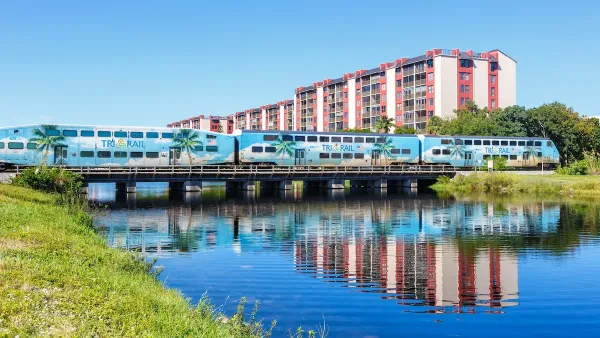
Florida’s Successful Commuter Rail Could Cease Operations in Two Years
After FDOT abruptly decreased its annual subsidy of Tri-Rail from $42 million to $15 million in July, the 80-mile rail line announced that without additional funding, it could cease operations by July 2027.
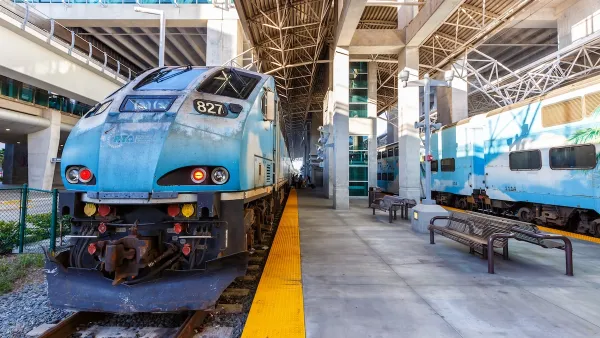
South Florida Commuter Rail Tops Pre-Pandemic Ridership
The Tri-Rail service connects Miami to Broward and Palm Beach counties.

Desperate measures: Advocates weigh draining Lake Powell to fill Colorado River
Draining the reservoir could reduce evaporation losses by a couple hundred thousand acre-feet.

Eastern Nebraska is running out of electricity
Data centers and electrification are straining eastern Nebraska’s grid, throttling economic development.

Move over, LA: St. Louis gears up for Olympics, invests millions in downtown redevelopment
The Missouri city will host the 2028 Olympic soccer group stage and knockout matches.

Mass. votes against statewide minimum lot size for single-family homes
Over 2 million residents voted on Question 7; it was decided by just over 30,000 votes.

Maryland’s $15 billion bridge project gains key approval
The Maryland Transit Authority said the project will create over 60,000 jobs and add $23 billion to the local economy.

‘No clear next steps’ for Chicago's permanent festival grounds
Eleventh Ward Ald. Nicole Lee has suggested Soldier Field as a possible location for the permanent event space.

FREE Course: Walkable City 1: Why Walkability?
After describing his path towards focusing on walkability as the essence of good planning, Jeff Speck marches through his five principal reasons for making more walkable places.
Reinventing Malls: Planning Alchemy—Turning Gray Fields Into Gold
The course focuses on the opportunities and imperatives that shape reinvention of mall sites.

City of Rosemead
Rutgers University, Edward J. Bloustein School of Planning and Public Policy
One Hundred Miles
University of Michigan School for Environment and Sustainability (SEAS)
Hunter College, City University of New York (CUNY)
The Architects Foundation
City of Cambridge
Montrose County
The Pocatello Development Authority